Readings Newsletter
Become a Readings Member to make your shopping experience even easier.
Sign in or sign up for free!
You’re not far away from qualifying for FREE standard shipping within Australia
You’ve qualified for FREE standard shipping within Australia
The cart is loading…


This title is printed to order. This book may have been self-published. If so, we cannot guarantee the quality of the content. In the main most books will have gone through the editing process however some may not. We therefore suggest that you be aware of this before ordering this book. If in doubt check either the author or publisher’s details as we are unable to accept any returns unless they are faulty. Please contact us if you have any questions.
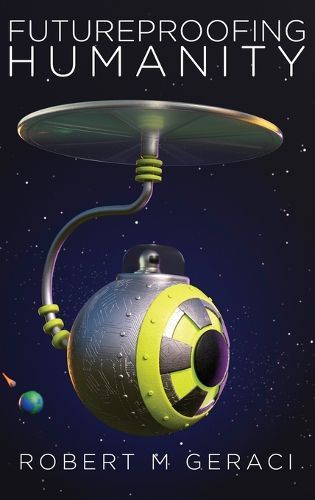
Asteroids and nuclear war, climate change and artificial intelligence...the universe is a dangerous place. In response to these and other "existential risks," 21st century futurists claim that only extraordinary investment in technology can save humanity from extinction. Thanks to advances in genetic engineering, artificial intelligence, urban design, and spaceflight, futurists hope that we will transcend earthly life, becoming immortal and traveling to distant stars.
Futureproofing Humanity offers a provocative new reading on this narrative of existential risk and the modern hope for technological salvation. We do, indeed, need a mythical view for our modern world. But to futureproof our species - to ensure we live for centuries and millennia to come - requires a responsible myth, one committed to our shared human (and possibly posthuman) civilization.
Robert M Geraci is the Knight Distinguished Chair for the Study of Religion and Culture at Knox College and is one of the world's leading experts on religion and technology. He is the author of Apocalyptic AI: Visions of Heaven in Robotics, Artificial Intelligence, and Virtual Reality (Oxford University Press 2010); Virtually Sacred: Myth and Meaning in World of Warcraft and Second Life (Oxford 2014); and Futures of Artificial Intelligence: Perspectives from India and the U.S. (Oxford 2022).
$9.00 standard shipping within Australia
FREE standard shipping within Australia for orders over $100.00
Express & International shipping calculated at checkout
Stock availability can be subject to change without notice. We recommend calling the shop or contacting our online team to check availability of low stock items. Please see our Shopping Online page for more details.
This title is printed to order. This book may have been self-published. If so, we cannot guarantee the quality of the content. In the main most books will have gone through the editing process however some may not. We therefore suggest that you be aware of this before ordering this book. If in doubt check either the author or publisher’s details as we are unable to accept any returns unless they are faulty. Please contact us if you have any questions.
Asteroids and nuclear war, climate change and artificial intelligence...the universe is a dangerous place. In response to these and other "existential risks," 21st century futurists claim that only extraordinary investment in technology can save humanity from extinction. Thanks to advances in genetic engineering, artificial intelligence, urban design, and spaceflight, futurists hope that we will transcend earthly life, becoming immortal and traveling to distant stars.
Futureproofing Humanity offers a provocative new reading on this narrative of existential risk and the modern hope for technological salvation. We do, indeed, need a mythical view for our modern world. But to futureproof our species - to ensure we live for centuries and millennia to come - requires a responsible myth, one committed to our shared human (and possibly posthuman) civilization.
Robert M Geraci is the Knight Distinguished Chair for the Study of Religion and Culture at Knox College and is one of the world's leading experts on religion and technology. He is the author of Apocalyptic AI: Visions of Heaven in Robotics, Artificial Intelligence, and Virtual Reality (Oxford University Press 2010); Virtually Sacred: Myth and Meaning in World of Warcraft and Second Life (Oxford 2014); and Futures of Artificial Intelligence: Perspectives from India and the U.S. (Oxford 2022).
Search our extensive online catalogue.
