Readings Newsletter
Become a Readings Member to make your shopping experience even easier.
Sign in or sign up for free!
You’re not far away from qualifying for FREE standard shipping within Australia
You’ve qualified for FREE standard shipping within Australia
The cart is loading…


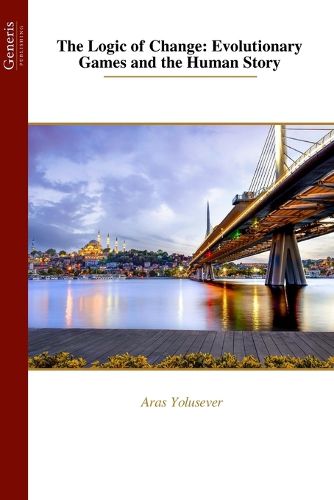
The book's central thesis is that human history unfolds as a dynamic game of strategic interaction, not as a sequence of static equilibria. As explained in the book, "[human] history is, in many ways, a record of strategic interaction". By applying evolutionary game theory - tools like replicator dynamics, evolutionarily stable strategies (ESS), and adaptive learning - the book shows how individual decisions aggregate into large-scale patterns. Unlike classical models that assume full rationality and fixed equilibria, the evolutionary lens emphasizes bounded rationality, feedback and path dependence. Strategies proliferate if they perform well relative to alternatives and vanish if they do not, so history is "less about equilibrium states and more about adaptive trajectories". This framework captures how norms emerge, persist or break down, explaining why some societies thrive while others collapse. The book uses game-theoretic models to reconceive institutions as outcomes of strategic interaction rather than fixed blueprints. Institutions (laws, norms, conventions) are seen as endogenous, evolving through feedback between individual behaviors and collective rules.
$9.00 standard shipping within Australia
FREE standard shipping within Australia for orders over $100.00
Express & International shipping calculated at checkout
Stock availability can be subject to change without notice. We recommend calling the shop or contacting our online team to check availability of low stock items. Please see our Shopping Online page for more details.
The book's central thesis is that human history unfolds as a dynamic game of strategic interaction, not as a sequence of static equilibria. As explained in the book, "[human] history is, in many ways, a record of strategic interaction". By applying evolutionary game theory - tools like replicator dynamics, evolutionarily stable strategies (ESS), and adaptive learning - the book shows how individual decisions aggregate into large-scale patterns. Unlike classical models that assume full rationality and fixed equilibria, the evolutionary lens emphasizes bounded rationality, feedback and path dependence. Strategies proliferate if they perform well relative to alternatives and vanish if they do not, so history is "less about equilibrium states and more about adaptive trajectories". This framework captures how norms emerge, persist or break down, explaining why some societies thrive while others collapse. The book uses game-theoretic models to reconceive institutions as outcomes of strategic interaction rather than fixed blueprints. Institutions (laws, norms, conventions) are seen as endogenous, evolving through feedback between individual behaviors and collective rules.
Search our extensive online catalogue.
