Readings Newsletter
Become a Readings Member to make your shopping experience even easier.
Sign in or sign up for free!
You’re not far away from qualifying for FREE standard shipping within Australia
You’ve qualified for FREE standard shipping within Australia
The cart is loading…


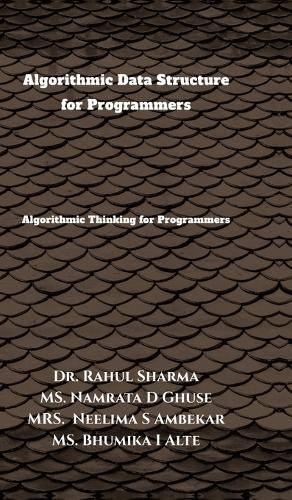
This title is printed to order. This book may have been self-published. If so, we cannot guarantee the quality of the content. In the main most books will have gone through the editing process however some may not. We therefore suggest that you be aware of this before ordering this book. If in doubt check either the author or publisher’s details as we are unable to accept any returns unless they are faulty. Please contact us if you have any questions.
In the world of programming, data structures serve as the backbone for developing efficient algorithms. This section explores fundamental and advanced data structures, focusing on how they support and enhance algorithmic problem-solving. Understanding the right data structure to use is crucial for optimizing performance, memory usage, and code clarity.
We begin with core structures such as arrays, linked lists, stacks, and queues, examining how they operate, where they are used, and their time and space complexities. Moving deeper, we cover hierarchical and non-linear structures like trees (binary trees, binary search trees, heaps, tries) and graphs (directed, undirected, weighted, unweighted), which play a critical role in solving complex real-world problems like searching, scheduling, and network modeling.
Special attention is given to hash tables and sets, which provide near-constant time access and are essential for fast lookups and caching. Advanced data structures such as segment trees, Fenwick trees, disjoint sets, and suffix arrays are also introduced for readers interested in competitive programming and systems-level design.
This section emphasizes the practical application of each structure with examples in common programming languages, illustrating how to implement, manipulate, and choose the most suitable data structure for a given problem.
$9.00 standard shipping within Australia
FREE standard shipping within Australia for orders over $100.00
Express & International shipping calculated at checkout
Stock availability can be subject to change without notice. We recommend calling the shop or contacting our online team to check availability of low stock items. Please see our Shopping Online page for more details.
This title is printed to order. This book may have been self-published. If so, we cannot guarantee the quality of the content. In the main most books will have gone through the editing process however some may not. We therefore suggest that you be aware of this before ordering this book. If in doubt check either the author or publisher’s details as we are unable to accept any returns unless they are faulty. Please contact us if you have any questions.
In the world of programming, data structures serve as the backbone for developing efficient algorithms. This section explores fundamental and advanced data structures, focusing on how they support and enhance algorithmic problem-solving. Understanding the right data structure to use is crucial for optimizing performance, memory usage, and code clarity.
We begin with core structures such as arrays, linked lists, stacks, and queues, examining how they operate, where they are used, and their time and space complexities. Moving deeper, we cover hierarchical and non-linear structures like trees (binary trees, binary search trees, heaps, tries) and graphs (directed, undirected, weighted, unweighted), which play a critical role in solving complex real-world problems like searching, scheduling, and network modeling.
Special attention is given to hash tables and sets, which provide near-constant time access and are essential for fast lookups and caching. Advanced data structures such as segment trees, Fenwick trees, disjoint sets, and suffix arrays are also introduced for readers interested in competitive programming and systems-level design.
This section emphasizes the practical application of each structure with examples in common programming languages, illustrating how to implement, manipulate, and choose the most suitable data structure for a given problem.
Search our extensive online catalogue.
