Readings Newsletter
Become a Readings Member to make your shopping experience even easier.
Sign in or sign up for free!
You’re not far away from qualifying for FREE standard shipping within Australia
You’ve qualified for FREE standard shipping within Australia
The cart is loading…


This title is printed to order. This book may have been self-published. If so, we cannot guarantee the quality of the content. In the main most books will have gone through the editing process however some may not. We therefore suggest that you be aware of this before ordering this book. If in doubt check either the author or publisher’s details as we are unable to accept any returns unless they are faulty. Please contact us if you have any questions.
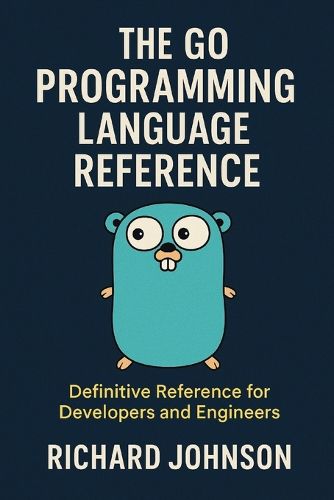
"The Go Programming Language Reference" serves as an authoritative guide to the syntax, semantics, and advanced features of Go, one of the most modern and efficient programming languages in use today. Beginning with a rigorous analysis of Go's lexical elements and statement structures, the book lays a foundation for developers by detailing tokens, literals, operators, code formatting, and documentation best practices-ensuring not only correctness but also readability and maintainability in Go codebases. Building on this foundation, the reference delves deeply into Go's core and composite types, covering everything from primitives and strings to arrays, slices, maps, structs, and pointers. It illuminates the language's robust type system, memory management nuances, and scoping principles before progressing to the intricate mechanisms of functions, methods, closures, and interfaces. Alongside thorough explorations of concurrency using goroutines and channels, the book provides essential insights into Go's sophisticated concurrency patterns and memory model-empowering developers to write safe, scalable, and highly-concurrent systems. Advanced chapters address Go's distinctive approach to error handling, robust build and tooling systems (including modules and cross-compilation), and runtime concerns such as garbage collection, reflection, and generics. Special attention is given to interoperability with C through cgo, as well as to unsafe operations and advanced diagnostic tooling. With best practices and design guidelines interwoven throughout, "The Go Programming Language Reference" is an indispensable resource for developers seeking a precise and in-depth understanding of Go's inner workings and practical application.
$9.00 standard shipping within Australia
FREE standard shipping within Australia for orders over $100.00
Express & International shipping calculated at checkout
Stock availability can be subject to change without notice. We recommend calling the shop or contacting our online team to check availability of low stock items. Please see our Shopping Online page for more details.
This title is printed to order. This book may have been self-published. If so, we cannot guarantee the quality of the content. In the main most books will have gone through the editing process however some may not. We therefore suggest that you be aware of this before ordering this book. If in doubt check either the author or publisher’s details as we are unable to accept any returns unless they are faulty. Please contact us if you have any questions.
"The Go Programming Language Reference" serves as an authoritative guide to the syntax, semantics, and advanced features of Go, one of the most modern and efficient programming languages in use today. Beginning with a rigorous analysis of Go's lexical elements and statement structures, the book lays a foundation for developers by detailing tokens, literals, operators, code formatting, and documentation best practices-ensuring not only correctness but also readability and maintainability in Go codebases. Building on this foundation, the reference delves deeply into Go's core and composite types, covering everything from primitives and strings to arrays, slices, maps, structs, and pointers. It illuminates the language's robust type system, memory management nuances, and scoping principles before progressing to the intricate mechanisms of functions, methods, closures, and interfaces. Alongside thorough explorations of concurrency using goroutines and channels, the book provides essential insights into Go's sophisticated concurrency patterns and memory model-empowering developers to write safe, scalable, and highly-concurrent systems. Advanced chapters address Go's distinctive approach to error handling, robust build and tooling systems (including modules and cross-compilation), and runtime concerns such as garbage collection, reflection, and generics. Special attention is given to interoperability with C through cgo, as well as to unsafe operations and advanced diagnostic tooling. With best practices and design guidelines interwoven throughout, "The Go Programming Language Reference" is an indispensable resource for developers seeking a precise and in-depth understanding of Go's inner workings and practical application.
Search our extensive online catalogue.
