Readings Newsletter
Become a Readings Member to make your shopping experience even easier.
Sign in or sign up for free!
You’re not far away from qualifying for FREE standard shipping within Australia
You’ve qualified for FREE standard shipping within Australia
The cart is loading…


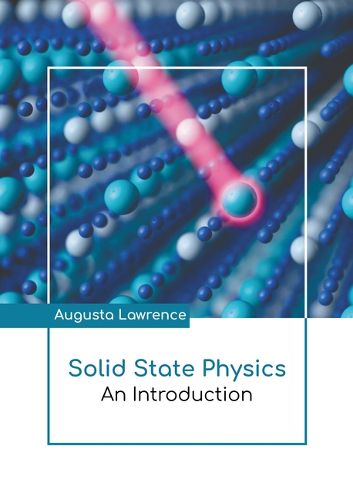
Solids consist of densely packed atoms whose interactions give rise to various properties such as magnetic, optical, thermal, mechanical, and electrical characteristics. The arrangement of atoms in a solid can be either in a regular geometric pattern, forming a crystal, or irregularly in an amorphous solid. The study of these aspects of solids fall within the purview of solid state physics, a branch of condensed matter physics. Solid state physics employs methodologies from electromagnetism, quantum mechanics, crystallography, and metallurgy to understand solids. Techniques like neutron diffraction, X-ray crystallography, and electron diffraction are used to investigate the crystalline structure of materials. Additionally, solid state physics explores phenomena such as quasicrystals, high-temperature superconductivity, and strongly correlated materials. It finds practical applications in the development and utilization of semiconductors and transistors. This book is a compilation of chapters that discuss the most vital concepts and theories in the field of solid state physics. The topics covered herein deal with the core subject of solid state physics. This book is an essential guide for both academicians and those who wish to pursue this discipline further.
$9.00 standard shipping within Australia
FREE standard shipping within Australia for orders over $100.00
Express & International shipping calculated at checkout
Stock availability can be subject to change without notice. We recommend calling the shop or contacting our online team to check availability of low stock items. Please see our Shopping Online page for more details.
Solids consist of densely packed atoms whose interactions give rise to various properties such as magnetic, optical, thermal, mechanical, and electrical characteristics. The arrangement of atoms in a solid can be either in a regular geometric pattern, forming a crystal, or irregularly in an amorphous solid. The study of these aspects of solids fall within the purview of solid state physics, a branch of condensed matter physics. Solid state physics employs methodologies from electromagnetism, quantum mechanics, crystallography, and metallurgy to understand solids. Techniques like neutron diffraction, X-ray crystallography, and electron diffraction are used to investigate the crystalline structure of materials. Additionally, solid state physics explores phenomena such as quasicrystals, high-temperature superconductivity, and strongly correlated materials. It finds practical applications in the development and utilization of semiconductors and transistors. This book is a compilation of chapters that discuss the most vital concepts and theories in the field of solid state physics. The topics covered herein deal with the core subject of solid state physics. This book is an essential guide for both academicians and those who wish to pursue this discipline further.
Search our extensive online catalogue.
