Readings Newsletter
Become a Readings Member to make your shopping experience even easier.
Sign in or sign up for free!
You’re not far away from qualifying for FREE standard shipping within Australia
You’ve qualified for FREE standard shipping within Australia
The cart is loading…


This title is printed to order. This book may have been self-published. If so, we cannot guarantee the quality of the content. In the main most books will have gone through the editing process however some may not. We therefore suggest that you be aware of this before ordering this book. If in doubt check either the author or publisher’s details as we are unable to accept any returns unless they are faulty. Please contact us if you have any questions.
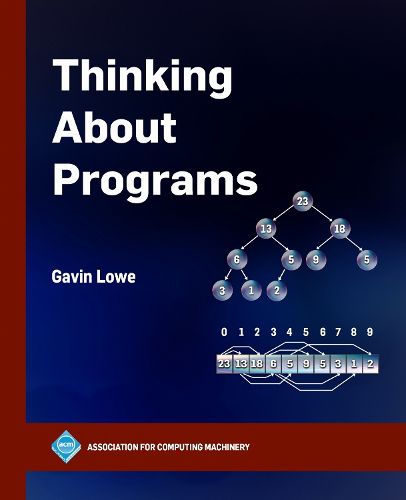
This book describes how to think about computer programs, and how to use mathematics as part of that thinking. Many books and online tutorials teach the basics of coding: the syntax of the language, and how to translate an algorithm into code. But how do you come up with that algorithm? And how can you be confident that the algorithm is correct?
The first part of the book considers small programs that use a loop, and how to demonstrate their correctness using loop invariants. It also covers some algorithms and algorithmic techniques that every programmer should know. The second half of the book considers slightly larger programs. It teaches the basics of modularisation, splitting up a program into manageable chunks. It teaches about abstract datatypes, values within a program that can be treated as mathematical values: how to specify their behaviours formally; and how to treat them as abstract mathematical objects when programming. It also teaches how to use data structures to represent abstract datatypes, and what it means for such a representation to be correct. And it presents some abstract datatypes and data structures that every programmer should know.
The book is aimed at those who want to obtain a better understanding of programs they work on, and so become better programmers. The target audience ranges from those who are just starting out, to professional programmers. The book aims to be pragmatic: the philosophy is to include enough formality to be convincing and to guide the programmer towards correct code, without getting bogged down in the mathematics.
$9.00 standard shipping within Australia
FREE standard shipping within Australia for orders over $100.00
Express & International shipping calculated at checkout
Stock availability can be subject to change without notice. We recommend calling the shop or contacting our online team to check availability of low stock items. Please see our Shopping Online page for more details.
This title is printed to order. This book may have been self-published. If so, we cannot guarantee the quality of the content. In the main most books will have gone through the editing process however some may not. We therefore suggest that you be aware of this before ordering this book. If in doubt check either the author or publisher’s details as we are unable to accept any returns unless they are faulty. Please contact us if you have any questions.
This book describes how to think about computer programs, and how to use mathematics as part of that thinking. Many books and online tutorials teach the basics of coding: the syntax of the language, and how to translate an algorithm into code. But how do you come up with that algorithm? And how can you be confident that the algorithm is correct?
The first part of the book considers small programs that use a loop, and how to demonstrate their correctness using loop invariants. It also covers some algorithms and algorithmic techniques that every programmer should know. The second half of the book considers slightly larger programs. It teaches the basics of modularisation, splitting up a program into manageable chunks. It teaches about abstract datatypes, values within a program that can be treated as mathematical values: how to specify their behaviours formally; and how to treat them as abstract mathematical objects when programming. It also teaches how to use data structures to represent abstract datatypes, and what it means for such a representation to be correct. And it presents some abstract datatypes and data structures that every programmer should know.
The book is aimed at those who want to obtain a better understanding of programs they work on, and so become better programmers. The target audience ranges from those who are just starting out, to professional programmers. The book aims to be pragmatic: the philosophy is to include enough formality to be convincing and to guide the programmer towards correct code, without getting bogged down in the mathematics.
Search our extensive online catalogue.
