Readings Newsletter
Become a Readings Member to make your shopping experience even easier.
Sign in or sign up for free!
You’re not far away from qualifying for FREE standard shipping within Australia
You’ve qualified for FREE standard shipping within Australia
The cart is loading…


This title is printed to order. This book may have been self-published. If so, we cannot guarantee the quality of the content. In the main most books will have gone through the editing process however some may not. We therefore suggest that you be aware of this before ordering this book. If in doubt check either the author or publisher’s details as we are unable to accept any returns unless they are faulty. Please contact us if you have any questions.
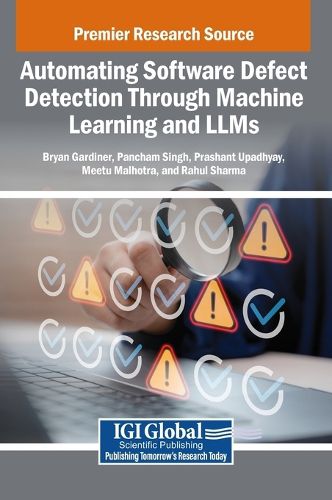
As software systems grow in complexity and scale, ensuring their reliability and quality becomes challenging. Traditional methods of defect detection are time-consuming, prone to errors, and inadequate for identifying issues. To address these limitations, the integration of machine learning (ML) techniques and large language models (LLMs) emerges as a transformative approach in automating software defect detection. ML algorithms can learn from historical bug data to predict vulnerabilities, while LLMs can detect anomalies with high accuracy. This convergence holds the potential to improve automation, software engineering, and defect detection, while introducing new challenges in interpretability, data bias, and model reliability that require further exploration. Automating Software Defect Detection Through Machine Learning and LLMs explores how cutting-edge technologies like machine learning (ML) and large language models (LLMs) transform software detection. It examines how these technologies enhance accuracy, scalability, and efficiency in identifying and mitigating software defects. This book covers topics such as algorithms, fraud detection, and software engineering, and is a useful resource for engineers, security professionals, academicians, researchers, and computer scientists.
$9.00 standard shipping within Australia
FREE standard shipping within Australia for orders over $100.00
Express & International shipping calculated at checkout
Stock availability can be subject to change without notice. We recommend calling the shop or contacting our online team to check availability of low stock items. Please see our Shopping Online page for more details.
This title is printed to order. This book may have been self-published. If so, we cannot guarantee the quality of the content. In the main most books will have gone through the editing process however some may not. We therefore suggest that you be aware of this before ordering this book. If in doubt check either the author or publisher’s details as we are unable to accept any returns unless they are faulty. Please contact us if you have any questions.
As software systems grow in complexity and scale, ensuring their reliability and quality becomes challenging. Traditional methods of defect detection are time-consuming, prone to errors, and inadequate for identifying issues. To address these limitations, the integration of machine learning (ML) techniques and large language models (LLMs) emerges as a transformative approach in automating software defect detection. ML algorithms can learn from historical bug data to predict vulnerabilities, while LLMs can detect anomalies with high accuracy. This convergence holds the potential to improve automation, software engineering, and defect detection, while introducing new challenges in interpretability, data bias, and model reliability that require further exploration. Automating Software Defect Detection Through Machine Learning and LLMs explores how cutting-edge technologies like machine learning (ML) and large language models (LLMs) transform software detection. It examines how these technologies enhance accuracy, scalability, and efficiency in identifying and mitigating software defects. This book covers topics such as algorithms, fraud detection, and software engineering, and is a useful resource for engineers, security professionals, academicians, researchers, and computer scientists.
Search our extensive online catalogue.
