Readings Newsletter
Become a Readings Member to make your shopping experience even easier.
Sign in or sign up for free!
You’re not far away from qualifying for FREE standard shipping within Australia
You’ve qualified for FREE standard shipping within Australia
The cart is loading…


This title is printed to order. This book may have been self-published. If so, we cannot guarantee the quality of the content. In the main most books will have gone through the editing process however some may not. We therefore suggest that you be aware of this before ordering this book. If in doubt check either the author or publisher’s details as we are unable to accept any returns unless they are faulty. Please contact us if you have any questions.
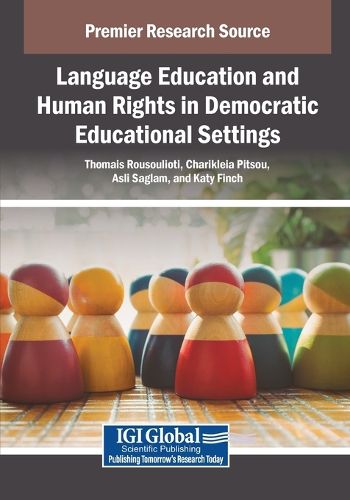
Language education plays a role in human rights within democratic educational settings, where inclusivity and equality are foundational principles. Access to quality language education empowers individuals to participate in society, exercise their rights, and preserve their cultural and linguistic identities. In multilingual and multicultural democracies, ensuring all students can learn languages promotes social cohesion and educational equality. Language education is imperative to human rights, supporting the broader goals of democracy, diversity, and justice in education. Language Education and Human Rights in Democratic Educational Settings explores the critical role of language at all levels of education and its profound impact on the human rights of plurilingual students. By examining the social, pedagogical and legal dimensions of language rights, it highlights how equitable language policies can empower students, foster inclusion, and ensure their right to a democratic education that respects and values their linguistic and cultural identities. This book covers topics such as democracy, artificial intelligence, and language rights, and is a useful resource for educators, sociologists, policymakers, academicians, researchers, and scientists.
$9.00 standard shipping within Australia
FREE standard shipping within Australia for orders over $100.00
Express & International shipping calculated at checkout
Stock availability can be subject to change without notice. We recommend calling the shop or contacting our online team to check availability of low stock items. Please see our Shopping Online page for more details.
This title is printed to order. This book may have been self-published. If so, we cannot guarantee the quality of the content. In the main most books will have gone through the editing process however some may not. We therefore suggest that you be aware of this before ordering this book. If in doubt check either the author or publisher’s details as we are unable to accept any returns unless they are faulty. Please contact us if you have any questions.
Language education plays a role in human rights within democratic educational settings, where inclusivity and equality are foundational principles. Access to quality language education empowers individuals to participate in society, exercise their rights, and preserve their cultural and linguistic identities. In multilingual and multicultural democracies, ensuring all students can learn languages promotes social cohesion and educational equality. Language education is imperative to human rights, supporting the broader goals of democracy, diversity, and justice in education. Language Education and Human Rights in Democratic Educational Settings explores the critical role of language at all levels of education and its profound impact on the human rights of plurilingual students. By examining the social, pedagogical and legal dimensions of language rights, it highlights how equitable language policies can empower students, foster inclusion, and ensure their right to a democratic education that respects and values their linguistic and cultural identities. This book covers topics such as democracy, artificial intelligence, and language rights, and is a useful resource for educators, sociologists, policymakers, academicians, researchers, and scientists.
Search our extensive online catalogue.
