Readings Newsletter
Become a Readings Member to make your shopping experience even easier.
Sign in or sign up for free!
You’re not far away from qualifying for FREE standard shipping within Australia
You’ve qualified for FREE standard shipping within Australia
The cart is loading…


This title is printed to order. This book may have been self-published. If so, we cannot guarantee the quality of the content. In the main most books will have gone through the editing process however some may not. We therefore suggest that you be aware of this before ordering this book. If in doubt check either the author or publisher’s details as we are unable to accept any returns unless they are faulty. Please contact us if you have any questions.
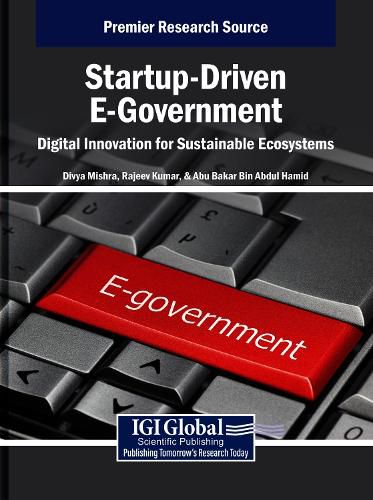
As startups create breakthrough innovation increasing public sector performance, they are often utilized to restructure government operations by leveraging digital technology and electronic governance. Measurable and simple solutions may improve efficiency in public services, boost the transparency of public institutions, and promote sustainability in areas ranging from education and farming to healthcare and business. The infusion of technology can upgrade traditional government models into innovative, customer-oriented, and sustainable foundations. Further exploration may revolutionize how e-governance tools can be used to enhance government responsiveness and create a sustainable digital ecosystem that benefits both the public and private sectors. Startup-Driven E-Government: Digital Innovation for Sustainable Ecosystems explores how digital changes are solving historical deficiencies in the management system. It offers actionable insights, focusing on how collaboration can overcome challenges and improve public services. Covering topics such as smart labor welfare, industrial automation, and women s safety, this book is an excellent resource for government officials, policymakers, entrepreneurs, engineers, urban developers, business owners, researchers, scholars, academicians, and more.
$9.00 standard shipping within Australia
FREE standard shipping within Australia for orders over $100.00
Express & International shipping calculated at checkout
Stock availability can be subject to change without notice. We recommend calling the shop or contacting our online team to check availability of low stock items. Please see our Shopping Online page for more details.
This title is printed to order. This book may have been self-published. If so, we cannot guarantee the quality of the content. In the main most books will have gone through the editing process however some may not. We therefore suggest that you be aware of this before ordering this book. If in doubt check either the author or publisher’s details as we are unable to accept any returns unless they are faulty. Please contact us if you have any questions.
As startups create breakthrough innovation increasing public sector performance, they are often utilized to restructure government operations by leveraging digital technology and electronic governance. Measurable and simple solutions may improve efficiency in public services, boost the transparency of public institutions, and promote sustainability in areas ranging from education and farming to healthcare and business. The infusion of technology can upgrade traditional government models into innovative, customer-oriented, and sustainable foundations. Further exploration may revolutionize how e-governance tools can be used to enhance government responsiveness and create a sustainable digital ecosystem that benefits both the public and private sectors. Startup-Driven E-Government: Digital Innovation for Sustainable Ecosystems explores how digital changes are solving historical deficiencies in the management system. It offers actionable insights, focusing on how collaboration can overcome challenges and improve public services. Covering topics such as smart labor welfare, industrial automation, and women s safety, this book is an excellent resource for government officials, policymakers, entrepreneurs, engineers, urban developers, business owners, researchers, scholars, academicians, and more.
Search our extensive online catalogue.
