Readings Newsletter
Become a Readings Member to make your shopping experience even easier.
Sign in or sign up for free!
You’re not far away from qualifying for FREE standard shipping within Australia
You’ve qualified for FREE standard shipping within Australia
The cart is loading…


This title is printed to order. This book may have been self-published. If so, we cannot guarantee the quality of the content. In the main most books will have gone through the editing process however some may not. We therefore suggest that you be aware of this before ordering this book. If in doubt check either the author or publisher’s details as we are unable to accept any returns unless they are faulty. Please contact us if you have any questions.
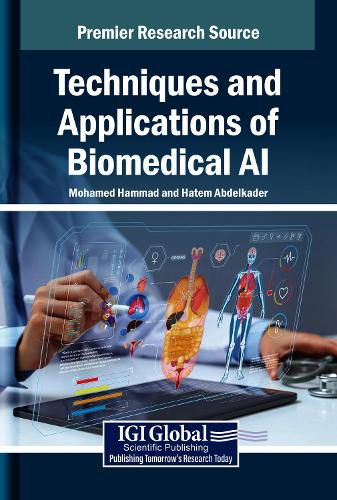
Artificial Intelligence (AI) has become a transformative force in the biomedical field, offering powerful tools to analyze complex data, enhance diagnostics, and support personalized medicine. Machine learning algorithms can identify patterns in genomic data for disease prediction, while deep learning models excel in medical imaging, detecting conditions like cancer or neurological disorders with high accuracy. NLP enables insights from clinical records, supporting decision-making and automating administrative tasks. Meanwhile, AI-powered robotics and smart sensors enhance surgical precision and patient monitoring. Further research of these applications may improve patient outcomes and streamline healthcare systems. Techniques and Applications of Biomedical AI delves into the rapidly evolving field of prompt engineering, specifically within the context of biomedical AI. It addresses both the theoretical foundations and practical applications of prompt engineering, highlighting its potential to revolutionize healthcare and biomedical research. This book covers topics such as biology, medical technologies, and risk management, and is a useful resource for biologists, medical and healthcare professionals, engineers, academicians, researchers, and scientists.
$9.00 standard shipping within Australia
FREE standard shipping within Australia for orders over $100.00
Express & International shipping calculated at checkout
Stock availability can be subject to change without notice. We recommend calling the shop or contacting our online team to check availability of low stock items. Please see our Shopping Online page for more details.
This title is printed to order. This book may have been self-published. If so, we cannot guarantee the quality of the content. In the main most books will have gone through the editing process however some may not. We therefore suggest that you be aware of this before ordering this book. If in doubt check either the author or publisher’s details as we are unable to accept any returns unless they are faulty. Please contact us if you have any questions.
Artificial Intelligence (AI) has become a transformative force in the biomedical field, offering powerful tools to analyze complex data, enhance diagnostics, and support personalized medicine. Machine learning algorithms can identify patterns in genomic data for disease prediction, while deep learning models excel in medical imaging, detecting conditions like cancer or neurological disorders with high accuracy. NLP enables insights from clinical records, supporting decision-making and automating administrative tasks. Meanwhile, AI-powered robotics and smart sensors enhance surgical precision and patient monitoring. Further research of these applications may improve patient outcomes and streamline healthcare systems. Techniques and Applications of Biomedical AI delves into the rapidly evolving field of prompt engineering, specifically within the context of biomedical AI. It addresses both the theoretical foundations and practical applications of prompt engineering, highlighting its potential to revolutionize healthcare and biomedical research. This book covers topics such as biology, medical technologies, and risk management, and is a useful resource for biologists, medical and healthcare professionals, engineers, academicians, researchers, and scientists.
Search our extensive online catalogue.
