Readings Newsletter
Become a Readings Member to make your shopping experience even easier.
Sign in or sign up for free!
You’re not far away from qualifying for FREE standard shipping within Australia
You’ve qualified for FREE standard shipping within Australia
The cart is loading…


This title is printed to order. This book may have been self-published. If so, we cannot guarantee the quality of the content. In the main most books will have gone through the editing process however some may not. We therefore suggest that you be aware of this before ordering this book. If in doubt check either the author or publisher’s details as we are unable to accept any returns unless they are faulty. Please contact us if you have any questions.
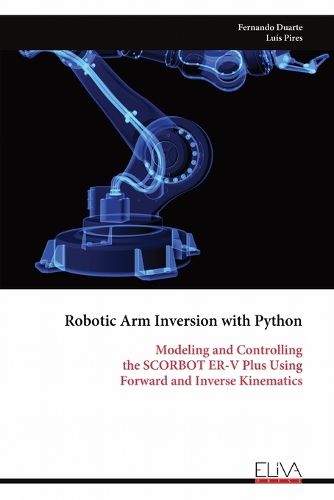
This book introduces a method for the inversion of a SCORBOT ER-V plus manipulator, aimed at meticulously analyzing the arm's movement from one spatial point to another. To implement this solution, it is necessary to identify only the starting and ending points in space, along with the geometric constraints of the manipulator. The SCORBOT-ER V plus is a straightforward top-bottom robot featuring five revolute joints, recognized for its reliability and safety, particularly in laboratory and training environments. This experiment provides students with practical experience in robotics, automation, and control systems, highlighting the principles related to the operation and causation of various phenomena. The analysis of object motion demonstrated that the output from the Python script closely aligned with the actual measurements obtained from the robotic arm. Differential movement is employed as a technique to analyze and characterize motion at different points of the robot, thereby facilitating the examination of robotic movement over short durations. This book discusses both forward modeling and inverse kinematics within the realm of robotics. The traditional D-H model is applied to create the mathematical framework essential for determining and assessing the position of the end-effector in a 5-Degree-Of-Freedom (5DOF) robot, which will then be used to calculate the necessary joint configurations.
$9.00 standard shipping within Australia
FREE standard shipping within Australia for orders over $100.00
Express & International shipping calculated at checkout
Stock availability can be subject to change without notice. We recommend calling the shop or contacting our online team to check availability of low stock items. Please see our Shopping Online page for more details.
This title is printed to order. This book may have been self-published. If so, we cannot guarantee the quality of the content. In the main most books will have gone through the editing process however some may not. We therefore suggest that you be aware of this before ordering this book. If in doubt check either the author or publisher’s details as we are unable to accept any returns unless they are faulty. Please contact us if you have any questions.
This book introduces a method for the inversion of a SCORBOT ER-V plus manipulator, aimed at meticulously analyzing the arm's movement from one spatial point to another. To implement this solution, it is necessary to identify only the starting and ending points in space, along with the geometric constraints of the manipulator. The SCORBOT-ER V plus is a straightforward top-bottom robot featuring five revolute joints, recognized for its reliability and safety, particularly in laboratory and training environments. This experiment provides students with practical experience in robotics, automation, and control systems, highlighting the principles related to the operation and causation of various phenomena. The analysis of object motion demonstrated that the output from the Python script closely aligned with the actual measurements obtained from the robotic arm. Differential movement is employed as a technique to analyze and characterize motion at different points of the robot, thereby facilitating the examination of robotic movement over short durations. This book discusses both forward modeling and inverse kinematics within the realm of robotics. The traditional D-H model is applied to create the mathematical framework essential for determining and assessing the position of the end-effector in a 5-Degree-Of-Freedom (5DOF) robot, which will then be used to calculate the necessary joint configurations.
Search our extensive online catalogue.
