Readings Newsletter
Become a Readings Member to make your shopping experience even easier.
Sign in or sign up for free!
You’re not far away from qualifying for FREE standard shipping within Australia
You’ve qualified for FREE standard shipping within Australia
The cart is loading…


This title is printed to order. This book may have been self-published. If so, we cannot guarantee the quality of the content. In the main most books will have gone through the editing process however some may not. We therefore suggest that you be aware of this before ordering this book. If in doubt check either the author or publisher’s details as we are unable to accept any returns unless they are faulty. Please contact us if you have any questions.
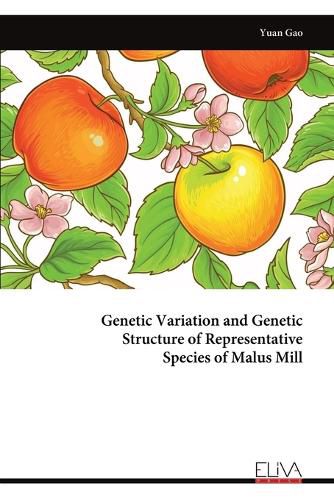
There are thirty-five species of Malus Mill. at least all over the world. China is a center of diversity for Malus Mill. with 27 native species including 21 wild species and 6 domesticated species. Among all these species, Malus baccata is the most widely distributed and diverse species of Malus. Malus sieversii is a relic species from the Tertiary period and has been confirmed by many scholars as the primitive ancestor of modern cultivated apples. Malus prunifolia is one of the cultivated species of Malus in China. Malus prunifolia has a long history of cultivation in various regions and is one of the traditional fruits in China. It has been widely distributed by humans in history and has been cultivated in North China, Northwest China, Northeast China, and East China. Malus robusta has been cultivated for more than two thousand years in China and now it has been used for rootstocks. These four species are typical representative species of Malus. Simple sequence repeat (SSR) detection with tailed primer M13(TP-M13-SSR) was used in the studies on genetic relationship and diversity for Malus robusta from Hebei province. 19 pairs of polymorphic SSR primers were screened to detect the polymorphism of Malus baccata from 7 sources. Genetic diversity and population structure analysis was carried out on the newly collected cultivated species Malus prunifolia using the fluorescent labelled SSR molecular markers. Four intergenic region in chloroplast genome of 49 newly collected germplasms of Malus prunifolia, 242 germplasms of Malus sieversii (Ledeb.) M. Roem. from 3 sources of Xinjiang Uygur Autonomous Region of China and 215 germplasms of Malus baccata were amplified by four primers, and their genetic variation was analyzed. Genetic diversity of Malus baccata, Malus sieversii, Malus prunifolia and Malus robusta and the phylogenetic relationship among different populations were explored from the perspective of maternal inheritance, which provided a theoretical basis for origin and genetic evolution, collection and protection of important perspective species in China.
$9.00 standard shipping within Australia
FREE standard shipping within Australia for orders over $100.00
Express & International shipping calculated at checkout
Stock availability can be subject to change without notice. We recommend calling the shop or contacting our online team to check availability of low stock items. Please see our Shopping Online page for more details.
This title is printed to order. This book may have been self-published. If so, we cannot guarantee the quality of the content. In the main most books will have gone through the editing process however some may not. We therefore suggest that you be aware of this before ordering this book. If in doubt check either the author or publisher’s details as we are unable to accept any returns unless they are faulty. Please contact us if you have any questions.
There are thirty-five species of Malus Mill. at least all over the world. China is a center of diversity for Malus Mill. with 27 native species including 21 wild species and 6 domesticated species. Among all these species, Malus baccata is the most widely distributed and diverse species of Malus. Malus sieversii is a relic species from the Tertiary period and has been confirmed by many scholars as the primitive ancestor of modern cultivated apples. Malus prunifolia is one of the cultivated species of Malus in China. Malus prunifolia has a long history of cultivation in various regions and is one of the traditional fruits in China. It has been widely distributed by humans in history and has been cultivated in North China, Northwest China, Northeast China, and East China. Malus robusta has been cultivated for more than two thousand years in China and now it has been used for rootstocks. These four species are typical representative species of Malus. Simple sequence repeat (SSR) detection with tailed primer M13(TP-M13-SSR) was used in the studies on genetic relationship and diversity for Malus robusta from Hebei province. 19 pairs of polymorphic SSR primers were screened to detect the polymorphism of Malus baccata from 7 sources. Genetic diversity and population structure analysis was carried out on the newly collected cultivated species Malus prunifolia using the fluorescent labelled SSR molecular markers. Four intergenic region in chloroplast genome of 49 newly collected germplasms of Malus prunifolia, 242 germplasms of Malus sieversii (Ledeb.) M. Roem. from 3 sources of Xinjiang Uygur Autonomous Region of China and 215 germplasms of Malus baccata were amplified by four primers, and their genetic variation was analyzed. Genetic diversity of Malus baccata, Malus sieversii, Malus prunifolia and Malus robusta and the phylogenetic relationship among different populations were explored from the perspective of maternal inheritance, which provided a theoretical basis for origin and genetic evolution, collection and protection of important perspective species in China.
Search our extensive online catalogue.
