Readings Newsletter
Become a Readings Member to make your shopping experience even easier.
Sign in or sign up for free!
You’re not far away from qualifying for FREE standard shipping within Australia
You’ve qualified for FREE standard shipping within Australia
The cart is loading…


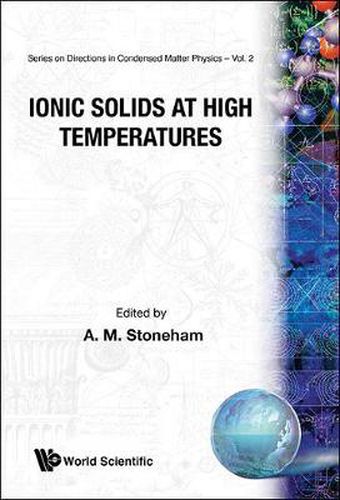
Most studies of solids at high temperatures have concentrated on rare gases or metals. However, in the last few years, the special properties of ionic solids at high temperatures have become increasingly important, with applications to geophysics, ceramic processing, nuclear fuels, solid-state electrolytes, and so on. This volume includes a review by W Hayes and M Hutchings on some of the recent experiments, notably comprehensive work on crystals with fluorite structure, including uranium dioxide. Such experiments can be both difficult to perform and are equally difficult to interpret. There have also been striking developments in the quantitative atomistic theory of defect properties and transport. All these are studied from different aspects in the following three reviews: on anharmonic lattice dynamics using the shell model (R Ball), on the prediction of defect free energies and transport (J Harding) and on dynamical simulations of superionic conductors (M Gillan).
$9.00 standard shipping within Australia
FREE standard shipping within Australia for orders over $100.00
Express & International shipping calculated at checkout
Stock availability can be subject to change without notice. We recommend calling the shop or contacting our online team to check availability of low stock items. Please see our Shopping Online page for more details.
Most studies of solids at high temperatures have concentrated on rare gases or metals. However, in the last few years, the special properties of ionic solids at high temperatures have become increasingly important, with applications to geophysics, ceramic processing, nuclear fuels, solid-state electrolytes, and so on. This volume includes a review by W Hayes and M Hutchings on some of the recent experiments, notably comprehensive work on crystals with fluorite structure, including uranium dioxide. Such experiments can be both difficult to perform and are equally difficult to interpret. There have also been striking developments in the quantitative atomistic theory of defect properties and transport. All these are studied from different aspects in the following three reviews: on anharmonic lattice dynamics using the shell model (R Ball), on the prediction of defect free energies and transport (J Harding) and on dynamical simulations of superionic conductors (M Gillan).
Search our extensive online catalogue.
