Readings Newsletter
Become a Readings Member to make your shopping experience even easier.
Sign in or sign up for free!
You’re not far away from qualifying for FREE standard shipping within Australia
You’ve qualified for FREE standard shipping within Australia
The cart is loading…


This title is printed to order. This book may have been self-published. If so, we cannot guarantee the quality of the content. In the main most books will have gone through the editing process however some may not. We therefore suggest that you be aware of this before ordering this book. If in doubt check either the author or publisher’s details as we are unable to accept any returns unless they are faulty. Please contact us if you have any questions.
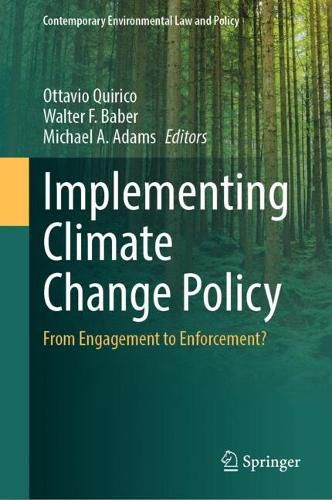
Over a time lapse of only about 170 years, the trajectory of greenhouse gas (GHG) in the atmosphere has exceeded the 1.5 degreesC security level established in the Paris Agreement. States and international organisations have thus far addressed global warming primarily by means of policy-making and law-making-that is, from the standpoint of 'primary' rules, but convergence is still limited. Climate science indeed warns that the timely achievement of carbon neutrality by 2050 currently necessitates drastic cuts in GHG emissions on a yearly basis. Can therefore a progressive implementation of 'secondary' norms, that is, sanctions and ensuing enforcement procedures, meaningfully contribute to fostering a fast transition to a low-carbon economy based on renewables and, possibly, nuclear energy and further innovative technologies, including corresponding adaptation measures? 'Hard' and 'soft' mechanisms, both 'public' and 'private' in nature, whereby enforceable sanctions integrate goal setting, pledges and a variety of behavioural incentives, disclose a fragmented 'enforcement deficit', which compels case-by-case decentralised solutions, whereby the threshold is by now set at a 2 degreesC temperature increase above pre-industrial levels, with fast-approaching tipping points.
$9.00 standard shipping within Australia
FREE standard shipping within Australia for orders over $100.00
Express & International shipping calculated at checkout
Stock availability can be subject to change without notice. We recommend calling the shop or contacting our online team to check availability of low stock items. Please see our Shopping Online page for more details.
This title is printed to order. This book may have been self-published. If so, we cannot guarantee the quality of the content. In the main most books will have gone through the editing process however some may not. We therefore suggest that you be aware of this before ordering this book. If in doubt check either the author or publisher’s details as we are unable to accept any returns unless they are faulty. Please contact us if you have any questions.
Over a time lapse of only about 170 years, the trajectory of greenhouse gas (GHG) in the atmosphere has exceeded the 1.5 degreesC security level established in the Paris Agreement. States and international organisations have thus far addressed global warming primarily by means of policy-making and law-making-that is, from the standpoint of 'primary' rules, but convergence is still limited. Climate science indeed warns that the timely achievement of carbon neutrality by 2050 currently necessitates drastic cuts in GHG emissions on a yearly basis. Can therefore a progressive implementation of 'secondary' norms, that is, sanctions and ensuing enforcement procedures, meaningfully contribute to fostering a fast transition to a low-carbon economy based on renewables and, possibly, nuclear energy and further innovative technologies, including corresponding adaptation measures? 'Hard' and 'soft' mechanisms, both 'public' and 'private' in nature, whereby enforceable sanctions integrate goal setting, pledges and a variety of behavioural incentives, disclose a fragmented 'enforcement deficit', which compels case-by-case decentralised solutions, whereby the threshold is by now set at a 2 degreesC temperature increase above pre-industrial levels, with fast-approaching tipping points.
Search our extensive online catalogue.
