Readings Newsletter
Become a Readings Member to make your shopping experience even easier.
Sign in or sign up for free!
You’re not far away from qualifying for FREE standard shipping within Australia
You’ve qualified for FREE standard shipping within Australia
The cart is loading…


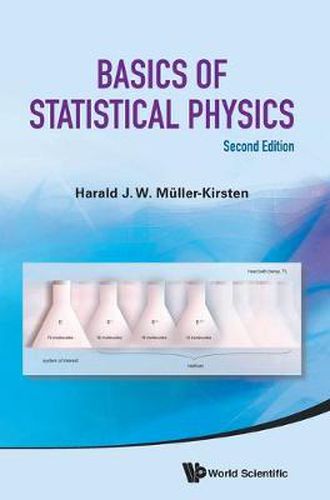
Statistics links microscopic and macroscopic phenomena, and requires for this reason a large number of microscopic elements like atoms. The results are values of maximum probability or of averaging. This introduction to statistical physics concentrates on the basic principles, and attempts to explain these in simple terms supplemented by numerous examples. These basic principles include the difference between classical and quantum statistics, a priori probabilities as related to degeneracies, the vital aspect of indistinguishability as compared with distinguishability in classical physics, the differences between conserved and non-conserved elements, the different ways of counting arrangements in the three statistics (Maxwell-Boltzmann, Fermi-Dirac, Bose-Einstein), the difference between maximization of the number of arrangements of elements, and averaging in the Darwin-Fowler method. Significant applications to solids, radiation and electrons in metals are treated in separate chapters, as well as Bose-Einstein condensation. This revised second edition contains an additional chapter on the Boltzmann transport equation along with appropriate applications. Also, more examples have been added throughout, as well as further references to literature.
$9.00 standard shipping within Australia
FREE standard shipping within Australia for orders over $100.00
Express & International shipping calculated at checkout
Stock availability can be subject to change without notice. We recommend calling the shop or contacting our online team to check availability of low stock items. Please see our Shopping Online page for more details.
Statistics links microscopic and macroscopic phenomena, and requires for this reason a large number of microscopic elements like atoms. The results are values of maximum probability or of averaging. This introduction to statistical physics concentrates on the basic principles, and attempts to explain these in simple terms supplemented by numerous examples. These basic principles include the difference between classical and quantum statistics, a priori probabilities as related to degeneracies, the vital aspect of indistinguishability as compared with distinguishability in classical physics, the differences between conserved and non-conserved elements, the different ways of counting arrangements in the three statistics (Maxwell-Boltzmann, Fermi-Dirac, Bose-Einstein), the difference between maximization of the number of arrangements of elements, and averaging in the Darwin-Fowler method. Significant applications to solids, radiation and electrons in metals are treated in separate chapters, as well as Bose-Einstein condensation. This revised second edition contains an additional chapter on the Boltzmann transport equation along with appropriate applications. Also, more examples have been added throughout, as well as further references to literature.
Search our extensive online catalogue.
