Readings Newsletter
Become a Readings Member to make your shopping experience even easier.
Sign in or sign up for free!
You’re not far away from qualifying for FREE standard shipping within Australia
You’ve qualified for FREE standard shipping within Australia
The cart is loading…


This title is printed to order. This book may have been self-published. If so, we cannot guarantee the quality of the content. In the main most books will have gone through the editing process however some may not. We therefore suggest that you be aware of this before ordering this book. If in doubt check either the author or publisher’s details as we are unable to accept any returns unless they are faulty. Please contact us if you have any questions.
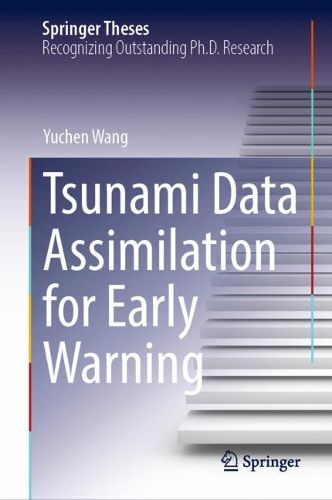
This book focuses on proposing a tsunami early warning system using data assimilation of offshore data. First, Green’s Function-based Tsunami Data Assimilation (GFTDA) is proposed to reduce the computation time for assimilation. It can forecast the waveform at Points of Interest (PoIs) by superposing Green’s functions between observational stations and PoIs. GFTDA achieves an equivalently high accuracy of tsunami forecasting to the previous approaches, while saving sufficient time to achieve an early warning. Second, a modified tsunami data assimilation method is explored for regions with a sparse observation network. The method uses interpolated waveforms at virtual stations to construct the complete wavefront for tsunami propagation. Its application to the 2009 Dusky Sound, New Zealand earthquake, and the 2015 Illapel earthquake revealed that adopting virtual stations greatly improved the tsunami forecasting accuracy for regions without a dense observation network. Finally, a real-time tsunami detection algorithm using Ensemble Empirical Mode Decomposition (EEMD) is presented. The tsunami signals of the offshore bottom pressure gauge can be automatically separated from the tidal components, seismic waves, and background noise. The algorithm could detect tsunami arrival with a short detection delay and accurately characterize the tsunami amplitude. Furthermore, the tsunami data assimilation approach is combined with the real-time tsunami detection algorithm, which is applied to the tsunami of the 2016 Fukushima earthquake. The proposed tsunami data assimilation approach can be put into practice with the help of the real-time tsunami detection algorithm.
$9.00 standard shipping within Australia
FREE standard shipping within Australia for orders over $100.00
Express & International shipping calculated at checkout
Stock availability can be subject to change without notice. We recommend calling the shop or contacting our online team to check availability of low stock items. Please see our Shopping Online page for more details.
This title is printed to order. This book may have been self-published. If so, we cannot guarantee the quality of the content. In the main most books will have gone through the editing process however some may not. We therefore suggest that you be aware of this before ordering this book. If in doubt check either the author or publisher’s details as we are unable to accept any returns unless they are faulty. Please contact us if you have any questions.
This book focuses on proposing a tsunami early warning system using data assimilation of offshore data. First, Green’s Function-based Tsunami Data Assimilation (GFTDA) is proposed to reduce the computation time for assimilation. It can forecast the waveform at Points of Interest (PoIs) by superposing Green’s functions between observational stations and PoIs. GFTDA achieves an equivalently high accuracy of tsunami forecasting to the previous approaches, while saving sufficient time to achieve an early warning. Second, a modified tsunami data assimilation method is explored for regions with a sparse observation network. The method uses interpolated waveforms at virtual stations to construct the complete wavefront for tsunami propagation. Its application to the 2009 Dusky Sound, New Zealand earthquake, and the 2015 Illapel earthquake revealed that adopting virtual stations greatly improved the tsunami forecasting accuracy for regions without a dense observation network. Finally, a real-time tsunami detection algorithm using Ensemble Empirical Mode Decomposition (EEMD) is presented. The tsunami signals of the offshore bottom pressure gauge can be automatically separated from the tidal components, seismic waves, and background noise. The algorithm could detect tsunami arrival with a short detection delay and accurately characterize the tsunami amplitude. Furthermore, the tsunami data assimilation approach is combined with the real-time tsunami detection algorithm, which is applied to the tsunami of the 2016 Fukushima earthquake. The proposed tsunami data assimilation approach can be put into practice with the help of the real-time tsunami detection algorithm.
Search our extensive online catalogue.
