Readings Newsletter
Become a Readings Member to make your shopping experience even easier.
Sign in or sign up for free!
You’re not far away from qualifying for FREE standard shipping within Australia
You’ve qualified for FREE standard shipping within Australia
The cart is loading…


This title is printed to order. This book may have been self-published. If so, we cannot guarantee the quality of the content. In the main most books will have gone through the editing process however some may not. We therefore suggest that you be aware of this before ordering this book. If in doubt check either the author or publisher’s details as we are unable to accept any returns unless they are faulty. Please contact us if you have any questions.
The two-volume Proceedings set CCIS 1637 and 1638 constitutes the refereed proceedings of the Third International Conference on Neural Computing for Advanced Applications, NCAA 2022, held in Jinan, China, during July 8-10, 2022.
The 77 papers included in these proceedings were carefully reviewed and selected from 205 submissions. These papers were categorized into 10 technical tracks, i.e., neural network theory, and cognitive sciences, machine learning, data mining, data security & privacy protection, and data-driven applications, computational intelligence, nature-inspired optimizers, and their engineering applications, cloud/edge/fog computing, the Internet of Things/Vehicles (IoT/IoV), and their system optimization, control systems, network synchronization, system integration, and industrial artificial intelligence, fuzzy logic, neuro-fuzzy systems, decision making, and their applications in management sciences, computer vision, image processing, and their industrial applications, natural language processing, machine translation, knowledge graphs, and their applications, Neural computing-based fault diagnosis, fault forecasting, prognostic management, and system modeling, and Spreading dynamics, forecasting, and other intelligent techniques against coronavirus disease (COVID-19).
$9.00 standard shipping within Australia
FREE standard shipping within Australia for orders over $100.00
Express & International shipping calculated at checkout
Stock availability can be subject to change without notice. We recommend calling the shop or contacting our online team to check availability of low stock items. Please see our Shopping Online page for more details.
This title is printed to order. This book may have been self-published. If so, we cannot guarantee the quality of the content. In the main most books will have gone through the editing process however some may not. We therefore suggest that you be aware of this before ordering this book. If in doubt check either the author or publisher’s details as we are unable to accept any returns unless they are faulty. Please contact us if you have any questions.
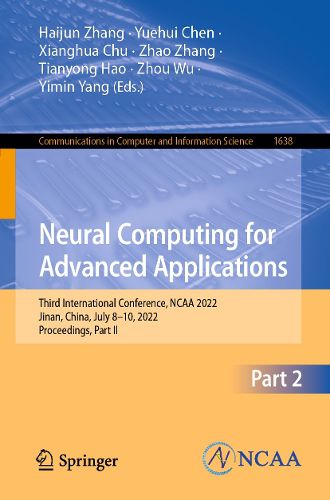
The two-volume Proceedings set CCIS 1637 and 1638 constitutes the refereed proceedings of the Third International Conference on Neural Computing for Advanced Applications, NCAA 2022, held in Jinan, China, during July 8-10, 2022.
The 77 papers included in these proceedings were carefully reviewed and selected from 205 submissions. These papers were categorized into 10 technical tracks, i.e., neural network theory, and cognitive sciences, machine learning, data mining, data security & privacy protection, and data-driven applications, computational intelligence, nature-inspired optimizers, and their engineering applications, cloud/edge/fog computing, the Internet of Things/Vehicles (IoT/IoV), and their system optimization, control systems, network synchronization, system integration, and industrial artificial intelligence, fuzzy logic, neuro-fuzzy systems, decision making, and their applications in management sciences, computer vision, image processing, and their industrial applications, natural language processing, machine translation, knowledge graphs, and their applications, Neural computing-based fault diagnosis, fault forecasting, prognostic management, and system modeling, and Spreading dynamics, forecasting, and other intelligent techniques against coronavirus disease (COVID-19).
Search our extensive online catalogue.
