Readings Newsletter
Become a Readings Member to make your shopping experience even easier.
Sign in or sign up for free!
You’re not far away from qualifying for FREE standard shipping within Australia
You’ve qualified for FREE standard shipping within Australia
The cart is loading…


This title is printed to order. This book may have been self-published. If so, we cannot guarantee the quality of the content. In the main most books will have gone through the editing process however some may not. We therefore suggest that you be aware of this before ordering this book. If in doubt check either the author or publisher’s details as we are unable to accept any returns unless they are faulty. Please contact us if you have any questions.
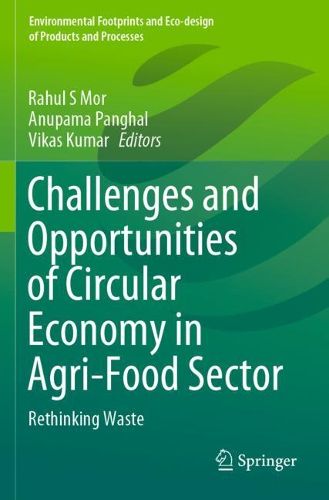
Global population by 2050 is predicted to be over 9 billion and accordingly, the production systems will demolish about 140 billion tons per year of minerals, ores, fossil fuels and biomass, i.e., thrice of the current need, and the food production itself has to be doubled. Optimized resource usage, lifecycle management, and reduced carbon emission have become a priority for agri-food businesses today, and circular economy (CE) helps for a sustainable and flexible way to grow without exhausting primary materials, and it thinks beyond recycling and resource usage. The word CE best relates to the resource and efficiency management, 6Rs, closed-loop production systems, zero waste and lifecycle engineering, reduced overconsumption of resources and waste generation, enriched system redesign and business model innovation, thereby leading to sustainable development goals. In this light, the book calls for theoretical and empirically sound contributions that are focused on the different aspects of the circular economy, 6R’s, sustainable production and consumption, closed-loop systems, etc. in the agri-food sector.
$9.00 standard shipping within Australia
FREE standard shipping within Australia for orders over $100.00
Express & International shipping calculated at checkout
Stock availability can be subject to change without notice. We recommend calling the shop or contacting our online team to check availability of low stock items. Please see our Shopping Online page for more details.
This title is printed to order. This book may have been self-published. If so, we cannot guarantee the quality of the content. In the main most books will have gone through the editing process however some may not. We therefore suggest that you be aware of this before ordering this book. If in doubt check either the author or publisher’s details as we are unable to accept any returns unless they are faulty. Please contact us if you have any questions.
Global population by 2050 is predicted to be over 9 billion and accordingly, the production systems will demolish about 140 billion tons per year of minerals, ores, fossil fuels and biomass, i.e., thrice of the current need, and the food production itself has to be doubled. Optimized resource usage, lifecycle management, and reduced carbon emission have become a priority for agri-food businesses today, and circular economy (CE) helps for a sustainable and flexible way to grow without exhausting primary materials, and it thinks beyond recycling and resource usage. The word CE best relates to the resource and efficiency management, 6Rs, closed-loop production systems, zero waste and lifecycle engineering, reduced overconsumption of resources and waste generation, enriched system redesign and business model innovation, thereby leading to sustainable development goals. In this light, the book calls for theoretical and empirically sound contributions that are focused on the different aspects of the circular economy, 6R’s, sustainable production and consumption, closed-loop systems, etc. in the agri-food sector.
Search our extensive online catalogue.
