Readings Newsletter
Become a Readings Member to make your shopping experience even easier.
Sign in or sign up for free!
You’re not far away from qualifying for FREE standard shipping within Australia
You’ve qualified for FREE standard shipping within Australia
The cart is loading…


This title is printed to order. This book may have been self-published. If so, we cannot guarantee the quality of the content. In the main most books will have gone through the editing process however some may not. We therefore suggest that you be aware of this before ordering this book. If in doubt check either the author or publisher’s details as we are unable to accept any returns unless they are faulty. Please contact us if you have any questions.
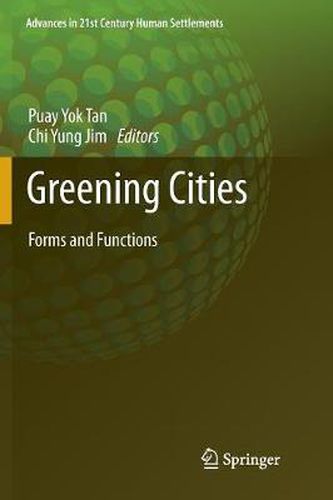
This book offers an overview of recent scientific and professional literature on urban greening and urban ecology, focusing on diverse disciplines such as landscape architecture, geography, urban ecology, urban climatology, biodiversity conservation, urban governance, architecture and urban hydrology. It includes contributions in which academics, public policy experts and practitioners share their considerable knowledge on the multi-faceted aspects of greening cities. The greening of cities has witnessed a global resurgence over the past two decades and has made a significant contribution to urban liveability and sustainability, as well as increasing resilience. As urban greening efforts continue to expand, it is useful to promote recent advances in our understanding of various aspects of planning, design and management of urban greenery, but at the same time, it is also important to realize that there are important gaps in our knowledge and that further research is needed. The book is organized in three main parts: concepts, functions and forms of urban greening. The first part examines the historical roots of greening cities and how the burgeoning field of urban ecology can contribute useful principles and strategies to guide the planning, design and management of urban greening. The second part shifts the focus to the diverse range of services - the functions - provided by urban greening, such as those related to urban climate, urban biodiversity, human health, and community building. The final part explores conventional, often neglected, but important forms of urban greenery such as urban woodlands and urban farms, as well as relatively recent forms of urban greenery like those integrated with buildings and waterways. It offers a ready reference resource for researchers, practitioners and policy-makers to grasp the critical issues and trigger further studies and applications in the quest for high-performance green cities.
$9.00 standard shipping within Australia
FREE standard shipping within Australia for orders over $100.00
Express & International shipping calculated at checkout
Stock availability can be subject to change without notice. We recommend calling the shop or contacting our online team to check availability of low stock items. Please see our Shopping Online page for more details.
This title is printed to order. This book may have been self-published. If so, we cannot guarantee the quality of the content. In the main most books will have gone through the editing process however some may not. We therefore suggest that you be aware of this before ordering this book. If in doubt check either the author or publisher’s details as we are unable to accept any returns unless they are faulty. Please contact us if you have any questions.
This book offers an overview of recent scientific and professional literature on urban greening and urban ecology, focusing on diverse disciplines such as landscape architecture, geography, urban ecology, urban climatology, biodiversity conservation, urban governance, architecture and urban hydrology. It includes contributions in which academics, public policy experts and practitioners share their considerable knowledge on the multi-faceted aspects of greening cities. The greening of cities has witnessed a global resurgence over the past two decades and has made a significant contribution to urban liveability and sustainability, as well as increasing resilience. As urban greening efforts continue to expand, it is useful to promote recent advances in our understanding of various aspects of planning, design and management of urban greenery, but at the same time, it is also important to realize that there are important gaps in our knowledge and that further research is needed. The book is organized in three main parts: concepts, functions and forms of urban greening. The first part examines the historical roots of greening cities and how the burgeoning field of urban ecology can contribute useful principles and strategies to guide the planning, design and management of urban greening. The second part shifts the focus to the diverse range of services - the functions - provided by urban greening, such as those related to urban climate, urban biodiversity, human health, and community building. The final part explores conventional, often neglected, but important forms of urban greenery such as urban woodlands and urban farms, as well as relatively recent forms of urban greenery like those integrated with buildings and waterways. It offers a ready reference resource for researchers, practitioners and policy-makers to grasp the critical issues and trigger further studies and applications in the quest for high-performance green cities.
Search our extensive online catalogue.
