Readings Newsletter
Become a Readings Member to make your shopping experience even easier.
Sign in or sign up for free!
You’re not far away from qualifying for FREE standard shipping within Australia
You’ve qualified for FREE standard shipping within Australia
The cart is loading…


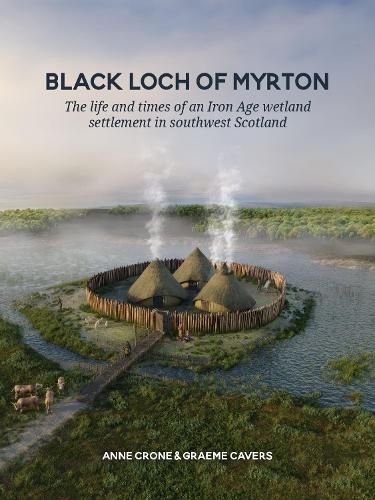
This monograph presents the results of excavations at an Iron Age wetland settlement at Black Loch of Myrton (BLM), located on the Machars peninsula in Wigtownshire, Scotland. Although first noted in the 1880s, the site remained unexamined until its rediscovery during modern drainage work. Excavations were carried out between 2013 and 2019 as part of the Scottish Wetland Archaeology Programme (SWAP), supported by Historic Environment Scotland and the UK Arts and Humanities Research Council. The project used a multidisciplinary approach, combining dendrochronology, radiocarbon dating, micromorphology, and multi-proxy environmental analyses.
The settlement, built on a natural peat island in a small loch, revealed three main episodes of occupation between the mid-5th and early 2nd century BCE. The earliest phase (c. 437 BCE) featured a log trackway, defensive palisades, and roundhouses. Around 425-420 BCE, the site expanded beyond the original boundaries with new roundhouses and an earthen rampart. A third phase (starting c. 278 BCE) involved substantial reconstruction of the perimeter defences using oak planks and palisades.
Excavation revealed exceptionally well-preserved wooden structures, hearths, and organic floor deposits. These finds allowed detailed reconstructions of domestic life, construction techniques, and the site's interaction with its environment. The site's deep stratigraphy and ecofactual remains - including plants, insects, animal bones, and lipid biomarkers - offer unique insights into living conditions, resource use, and spatial organisation.
Thanks to precise dating through dendrochronology and radiocarbon modelling, the research demonstrates that wetland settlements were an integral part of Iron Age life in northern Britain. These findings reshape our understanding of settlement patterns, defence, and resource management during the mid to late first millennium BCE.
$9.00 standard shipping within Australia
FREE standard shipping within Australia for orders over $100.00
Express & International shipping calculated at checkout
Stock availability can be subject to change without notice. We recommend calling the shop or contacting our online team to check availability of low stock items. Please see our Shopping Online page for more details.
This monograph presents the results of excavations at an Iron Age wetland settlement at Black Loch of Myrton (BLM), located on the Machars peninsula in Wigtownshire, Scotland. Although first noted in the 1880s, the site remained unexamined until its rediscovery during modern drainage work. Excavations were carried out between 2013 and 2019 as part of the Scottish Wetland Archaeology Programme (SWAP), supported by Historic Environment Scotland and the UK Arts and Humanities Research Council. The project used a multidisciplinary approach, combining dendrochronology, radiocarbon dating, micromorphology, and multi-proxy environmental analyses.
The settlement, built on a natural peat island in a small loch, revealed three main episodes of occupation between the mid-5th and early 2nd century BCE. The earliest phase (c. 437 BCE) featured a log trackway, defensive palisades, and roundhouses. Around 425-420 BCE, the site expanded beyond the original boundaries with new roundhouses and an earthen rampart. A third phase (starting c. 278 BCE) involved substantial reconstruction of the perimeter defences using oak planks and palisades.
Excavation revealed exceptionally well-preserved wooden structures, hearths, and organic floor deposits. These finds allowed detailed reconstructions of domestic life, construction techniques, and the site's interaction with its environment. The site's deep stratigraphy and ecofactual remains - including plants, insects, animal bones, and lipid biomarkers - offer unique insights into living conditions, resource use, and spatial organisation.
Thanks to precise dating through dendrochronology and radiocarbon modelling, the research demonstrates that wetland settlements were an integral part of Iron Age life in northern Britain. These findings reshape our understanding of settlement patterns, defence, and resource management during the mid to late first millennium BCE.
Search our extensive online catalogue.
