Readings Newsletter
Become a Readings Member to make your shopping experience even easier.
Sign in or sign up for free!
You’re not far away from qualifying for FREE standard shipping within Australia
You’ve qualified for FREE standard shipping within Australia
The cart is loading…


This title is printed to order. This book may have been self-published. If so, we cannot guarantee the quality of the content. In the main most books will have gone through the editing process however some may not. We therefore suggest that you be aware of this before ordering this book. If in doubt check either the author or publisher’s details as we are unable to accept any returns unless they are faulty. Please contact us if you have any questions.
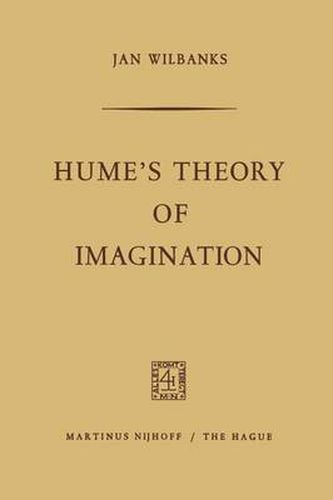
The present work is, as its title indicates, a study of Hume’s theory of imagination. Naturally, it is a study of a particular sort. It has a certain scope and limitations, takes a certain line of approach, exhibits certain emphases, has certain ends-in-view, etc. As an initial step in specifying the nature of this study, I shall indicate its central problem, i. e. , that problem to the solution of which the solutions of the various other problems with which it is concerned are merely means. The central problem of this study is that of determining how Hume’s theory of im agination is related to, or involved in, the generic features and main lines of argument of his philosophy of the human understanding. The expression philosophy of the human understanding is obvious to allude to a restriction on the scope of this investigation. ly intended Actually, it is a title suggested to me by two of Hume’s philosophical writings; and to anyone who is even modestly acquainted with these writings, its reference should be no mystery. Hume published the first two so-called Books of his A Treatise of Human Nature in 1739. The first of these two Books was entitled Of the Human Understanding.
Nine years later, he published a work under the title, An Enquiry Con cerning Human Understanding.
$9.00 standard shipping within Australia
FREE standard shipping within Australia for orders over $100.00
Express & International shipping calculated at checkout
Stock availability can be subject to change without notice. We recommend calling the shop or contacting our online team to check availability of low stock items. Please see our Shopping Online page for more details.
This title is printed to order. This book may have been self-published. If so, we cannot guarantee the quality of the content. In the main most books will have gone through the editing process however some may not. We therefore suggest that you be aware of this before ordering this book. If in doubt check either the author or publisher’s details as we are unable to accept any returns unless they are faulty. Please contact us if you have any questions.
The present work is, as its title indicates, a study of Hume’s theory of imagination. Naturally, it is a study of a particular sort. It has a certain scope and limitations, takes a certain line of approach, exhibits certain emphases, has certain ends-in-view, etc. As an initial step in specifying the nature of this study, I shall indicate its central problem, i. e. , that problem to the solution of which the solutions of the various other problems with which it is concerned are merely means. The central problem of this study is that of determining how Hume’s theory of im agination is related to, or involved in, the generic features and main lines of argument of his philosophy of the human understanding. The expression philosophy of the human understanding is obvious to allude to a restriction on the scope of this investigation. ly intended Actually, it is a title suggested to me by two of Hume’s philosophical writings; and to anyone who is even modestly acquainted with these writings, its reference should be no mystery. Hume published the first two so-called Books of his A Treatise of Human Nature in 1739. The first of these two Books was entitled Of the Human Understanding.
Nine years later, he published a work under the title, An Enquiry Con cerning Human Understanding.
Search our extensive online catalogue.
