Readings Newsletter
Become a Readings Member to make your shopping experience even easier.
Sign in or sign up for free!
You’re not far away from qualifying for FREE standard shipping within Australia
You’ve qualified for FREE standard shipping within Australia
The cart is loading…


This title is printed to order. This book may have been self-published. If so, we cannot guarantee the quality of the content. In the main most books will have gone through the editing process however some may not. We therefore suggest that you be aware of this before ordering this book. If in doubt check either the author or publisher’s details as we are unable to accept any returns unless they are faulty. Please contact us if you have any questions.
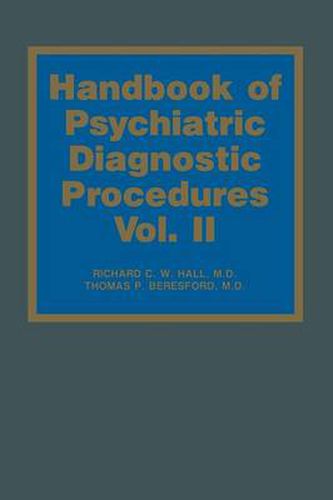
The first volume of this Handbook discussed neuroendocrine diagnostic tests and the diagnostic use of central nervous system amine metabolites. That volume further reviewed the toxicological evaluation of patients and the laboratory evalua tion of treatment outcome. It suggested a system for evaluating newly admitted psychiatric patients and dermed the scope of diagnostic procedures available in the emergency department. Volume II focuses on the use and interpretation of electro physiologic and radiologic diagnostic tests in psychiatry and then explores the laboratory evaluation of special groups of patients. The clinical sections of this volume are designed to assist the physician in in stituting a proper workup for specific patients and defining tests which will assist them in the differential diagnosis of various psychiatric disorders. Such workups are critical to exclude possible organic disorders which can present with psychia tric symptoms. The workup suggested for the various classes of patients will assist the clini cian with differential diagnosis, provide base-line information for long-term follow up, delineate biological perimeters at the beginning of treatment, protect the pa tient from unrecognized cardiac, renal, hepatic, or endocrine disorders which could be adversely affected by the administration of medications, and provide a rational sequencing of workup for particular disorders to insure the most thorough yet cost efficient approach to the patient.
$9.00 standard shipping within Australia
FREE standard shipping within Australia for orders over $100.00
Express & International shipping calculated at checkout
Stock availability can be subject to change without notice. We recommend calling the shop or contacting our online team to check availability of low stock items. Please see our Shopping Online page for more details.
This title is printed to order. This book may have been self-published. If so, we cannot guarantee the quality of the content. In the main most books will have gone through the editing process however some may not. We therefore suggest that you be aware of this before ordering this book. If in doubt check either the author or publisher’s details as we are unable to accept any returns unless they are faulty. Please contact us if you have any questions.
The first volume of this Handbook discussed neuroendocrine diagnostic tests and the diagnostic use of central nervous system amine metabolites. That volume further reviewed the toxicological evaluation of patients and the laboratory evalua tion of treatment outcome. It suggested a system for evaluating newly admitted psychiatric patients and dermed the scope of diagnostic procedures available in the emergency department. Volume II focuses on the use and interpretation of electro physiologic and radiologic diagnostic tests in psychiatry and then explores the laboratory evaluation of special groups of patients. The clinical sections of this volume are designed to assist the physician in in stituting a proper workup for specific patients and defining tests which will assist them in the differential diagnosis of various psychiatric disorders. Such workups are critical to exclude possible organic disorders which can present with psychia tric symptoms. The workup suggested for the various classes of patients will assist the clini cian with differential diagnosis, provide base-line information for long-term follow up, delineate biological perimeters at the beginning of treatment, protect the pa tient from unrecognized cardiac, renal, hepatic, or endocrine disorders which could be adversely affected by the administration of medications, and provide a rational sequencing of workup for particular disorders to insure the most thorough yet cost efficient approach to the patient.
Search our extensive online catalogue.
