Readings Newsletter
Become a Readings Member to make your shopping experience even easier.
Sign in or sign up for free!
You’re not far away from qualifying for FREE standard shipping within Australia
You’ve qualified for FREE standard shipping within Australia
The cart is loading…


This title is printed to order. This book may have been self-published. If so, we cannot guarantee the quality of the content. In the main most books will have gone through the editing process however some may not. We therefore suggest that you be aware of this before ordering this book. If in doubt check either the author or publisher’s details as we are unable to accept any returns unless they are faulty. Please contact us if you have any questions.
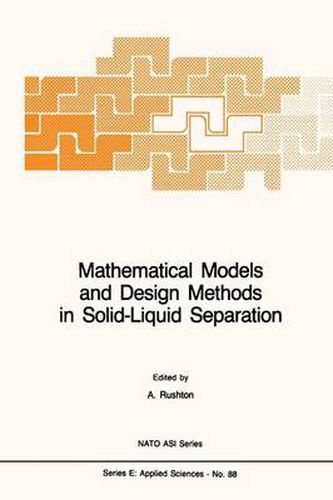
The separation of finely-divided solids from liquids constitutes an important stage in many industrial processes. Separation of mixtures ranging from highly concentrated slurries to slightly turbid liquids must be effected in circumstances where the solids, liquid or both phases may have value. Separations may be achieved by use of a membrane or filter medium which, positioned in the path of a flowing suspension, will allow passage of the fluid whilst retaining solids on the surface or within the medium. Alternatively the two phases may be separated by sedimentation processes involving gravitational or centrifugal force. In either mode, separation difficulties are sometimes experienced with the result that solid-liquid separation is often a bottleneck in commercial plants. Operational difficulties and plant failures are associated with the random nature of the particles being separated; variations in size, shape, states of aggregation, compressibility, etc. , produce a wide range of problems. Plugging of the filter medium or the collapse of the solids under applied stress lead to slow flowrates of liquid. The colloidal nature of some precipitates makes separation by settling virtually impossible without the use of chemical agents to enhance the size of basic units and to reduce repulsive surface forces. Unit operations such as filtration, comminution, etc. , involve a seemingly bewildering array of machines which makes plant selection a difficult step and reflects the uncer tainties attaching to operations involving the solid )hase. Many types of pressure, vacuum and centrifugal filter are available.
$9.00 standard shipping within Australia
FREE standard shipping within Australia for orders over $100.00
Express & International shipping calculated at checkout
Stock availability can be subject to change without notice. We recommend calling the shop or contacting our online team to check availability of low stock items. Please see our Shopping Online page for more details.
This title is printed to order. This book may have been self-published. If so, we cannot guarantee the quality of the content. In the main most books will have gone through the editing process however some may not. We therefore suggest that you be aware of this before ordering this book. If in doubt check either the author or publisher’s details as we are unable to accept any returns unless they are faulty. Please contact us if you have any questions.
The separation of finely-divided solids from liquids constitutes an important stage in many industrial processes. Separation of mixtures ranging from highly concentrated slurries to slightly turbid liquids must be effected in circumstances where the solids, liquid or both phases may have value. Separations may be achieved by use of a membrane or filter medium which, positioned in the path of a flowing suspension, will allow passage of the fluid whilst retaining solids on the surface or within the medium. Alternatively the two phases may be separated by sedimentation processes involving gravitational or centrifugal force. In either mode, separation difficulties are sometimes experienced with the result that solid-liquid separation is often a bottleneck in commercial plants. Operational difficulties and plant failures are associated with the random nature of the particles being separated; variations in size, shape, states of aggregation, compressibility, etc. , produce a wide range of problems. Plugging of the filter medium or the collapse of the solids under applied stress lead to slow flowrates of liquid. The colloidal nature of some precipitates makes separation by settling virtually impossible without the use of chemical agents to enhance the size of basic units and to reduce repulsive surface forces. Unit operations such as filtration, comminution, etc. , involve a seemingly bewildering array of machines which makes plant selection a difficult step and reflects the uncer tainties attaching to operations involving the solid )hase. Many types of pressure, vacuum and centrifugal filter are available.
Search our extensive online catalogue.
