Readings Newsletter
Become a Readings Member to make your shopping experience even easier.
Sign in or sign up for free!
You’re not far away from qualifying for FREE standard shipping within Australia
You’ve qualified for FREE standard shipping within Australia
The cart is loading…


This title is printed to order. This book may have been self-published. If so, we cannot guarantee the quality of the content. In the main most books will have gone through the editing process however some may not. We therefore suggest that you be aware of this before ordering this book. If in doubt check either the author or publisher’s details as we are unable to accept any returns unless they are faulty. Please contact us if you have any questions.
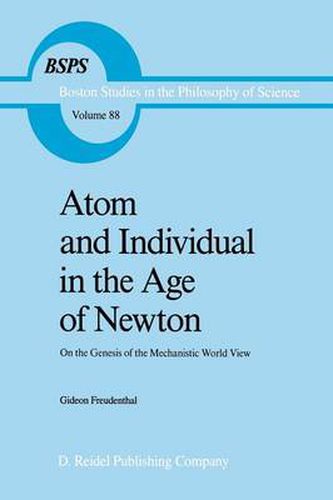
In this stimulating investigation, Gideon Freudenthal has linked social history with the history of science by formulating an interesting proposal: that the supposed influence of social theory may be seen as actual through its co herence with the process of formation of physical concepts. The reinterpre tation of the development of science in the seventeenth century, now widely influential, receives at Freudenthal’s hand its most persuasive statement, most significantly because of his attention to the theoretical form which is charac teristic. of classical Newtonian mechanics. He pursues the sources of the parallels that may be noted between that mechanics and the dominant philosophical systems and social theories of the time; and in a fascinating development Freudenthal shows how a quite precise method - as he descriptively labels it, the ‘analytic-synthetic method’ - which underlay the Newtonian form of theoretical argument, was due to certain interpretive premisses concerning particle mechanics. If he is right, these depend upon a particular stage of con ceptual achievement in the theories of both society and nature; further, that the conceptual was generalized philosophically; but, strikingly, Freudenthal shows that this concept-formation itself was linked to the specific social relations of the times of Newton and Hobbes.
$9.00 standard shipping within Australia
FREE standard shipping within Australia for orders over $100.00
Express & International shipping calculated at checkout
Stock availability can be subject to change without notice. We recommend calling the shop or contacting our online team to check availability of low stock items. Please see our Shopping Online page for more details.
This title is printed to order. This book may have been self-published. If so, we cannot guarantee the quality of the content. In the main most books will have gone through the editing process however some may not. We therefore suggest that you be aware of this before ordering this book. If in doubt check either the author or publisher’s details as we are unable to accept any returns unless they are faulty. Please contact us if you have any questions.
In this stimulating investigation, Gideon Freudenthal has linked social history with the history of science by formulating an interesting proposal: that the supposed influence of social theory may be seen as actual through its co herence with the process of formation of physical concepts. The reinterpre tation of the development of science in the seventeenth century, now widely influential, receives at Freudenthal’s hand its most persuasive statement, most significantly because of his attention to the theoretical form which is charac teristic. of classical Newtonian mechanics. He pursues the sources of the parallels that may be noted between that mechanics and the dominant philosophical systems and social theories of the time; and in a fascinating development Freudenthal shows how a quite precise method - as he descriptively labels it, the ‘analytic-synthetic method’ - which underlay the Newtonian form of theoretical argument, was due to certain interpretive premisses concerning particle mechanics. If he is right, these depend upon a particular stage of con ceptual achievement in the theories of both society and nature; further, that the conceptual was generalized philosophically; but, strikingly, Freudenthal shows that this concept-formation itself was linked to the specific social relations of the times of Newton and Hobbes.
Search our extensive online catalogue.
