Readings Newsletter
Become a Readings Member to make your shopping experience even easier.
Sign in or sign up for free!
You’re not far away from qualifying for FREE standard shipping within Australia
You’ve qualified for FREE standard shipping within Australia
The cart is loading…


This title is printed to order. This book may have been self-published. If so, we cannot guarantee the quality of the content. In the main most books will have gone through the editing process however some may not. We therefore suggest that you be aware of this before ordering this book. If in doubt check either the author or publisher’s details as we are unable to accept any returns unless they are faulty. Please contact us if you have any questions.
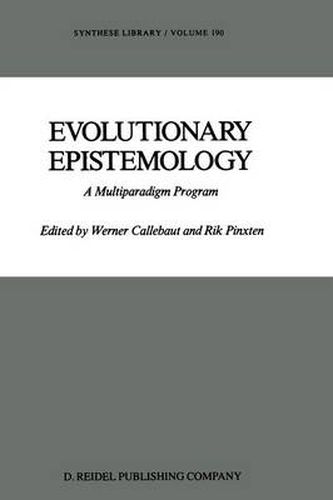
This volume has its already distant or1g1n in an inter national conference on Evolutionary Epistemology the editors organized at the University of Ghent in November 1984. This conference aimed to follow up the endeavor started at the ERISS (Epistemologically Relevant Internalist Sociology of Science) conference organized by Don Campbell and Alex Rosen berg at Cazenovia Lake, New York, in June 1981, whilst in jecting the gist of certain current continental intellectual developments into a debate whose focus, we thought, was in danger of being narrowed too much, considering the still underdeveloped state of affairs in the field. Broadly speaking, evolutionary epistemology today con sists of two interrelated, yet qualitatively distinct inves tigative efforts. Both are drawing on Darwinian concepts, which may explain why many people have failed to discriminate them. One is the study of the evolution of the cognitive apparatus of living organisms, which is first and foremost the province of biologists and psychologists (H. C. Plotkin, Ed. , Learning, Development, and Culture: Essays in Evolu tionary Epistemology, New York, Wiley, 1984), although quite a few philosophers - professional or vocational - have also felt the need to express themselves on this vast subject (F. M. Wuketits, Ed. , Conce ts and Approaches in Evolutionary Epistemology, Dordrecht Boston, Reidel, 1984). The other approach deals with the evolution of science, and has been dominated hitherto by (allegedly) ‘naturalized’ philosophers; no book-length survey of this literature is available at present.
$9.00 standard shipping within Australia
FREE standard shipping within Australia for orders over $100.00
Express & International shipping calculated at checkout
Stock availability can be subject to change without notice. We recommend calling the shop or contacting our online team to check availability of low stock items. Please see our Shopping Online page for more details.
This title is printed to order. This book may have been self-published. If so, we cannot guarantee the quality of the content. In the main most books will have gone through the editing process however some may not. We therefore suggest that you be aware of this before ordering this book. If in doubt check either the author or publisher’s details as we are unable to accept any returns unless they are faulty. Please contact us if you have any questions.
This volume has its already distant or1g1n in an inter national conference on Evolutionary Epistemology the editors organized at the University of Ghent in November 1984. This conference aimed to follow up the endeavor started at the ERISS (Epistemologically Relevant Internalist Sociology of Science) conference organized by Don Campbell and Alex Rosen berg at Cazenovia Lake, New York, in June 1981, whilst in jecting the gist of certain current continental intellectual developments into a debate whose focus, we thought, was in danger of being narrowed too much, considering the still underdeveloped state of affairs in the field. Broadly speaking, evolutionary epistemology today con sists of two interrelated, yet qualitatively distinct inves tigative efforts. Both are drawing on Darwinian concepts, which may explain why many people have failed to discriminate them. One is the study of the evolution of the cognitive apparatus of living organisms, which is first and foremost the province of biologists and psychologists (H. C. Plotkin, Ed. , Learning, Development, and Culture: Essays in Evolu tionary Epistemology, New York, Wiley, 1984), although quite a few philosophers - professional or vocational - have also felt the need to express themselves on this vast subject (F. M. Wuketits, Ed. , Conce ts and Approaches in Evolutionary Epistemology, Dordrecht Boston, Reidel, 1984). The other approach deals with the evolution of science, and has been dominated hitherto by (allegedly) ‘naturalized’ philosophers; no book-length survey of this literature is available at present.
Search our extensive online catalogue.
