Readings Newsletter
Become a Readings Member to make your shopping experience even easier.
Sign in or sign up for free!
You’re not far away from qualifying for FREE standard shipping within Australia
You’ve qualified for FREE standard shipping within Australia
The cart is loading…


This title is printed to order. This book may have been self-published. If so, we cannot guarantee the quality of the content. In the main most books will have gone through the editing process however some may not. We therefore suggest that you be aware of this before ordering this book. If in doubt check either the author or publisher’s details as we are unable to accept any returns unless they are faulty. Please contact us if you have any questions.
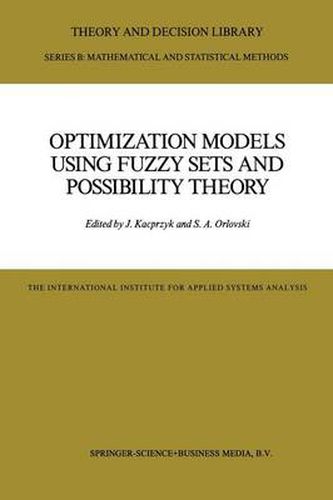
Optimization is of central concern to a number of discip lines. Operations Research and Decision Theory are often consi dered to be identical with optimizationo But also in other areas such as engineering design, regional policy, logistics and many others, the search for optimal solutions is one of the prime goals. The methods and models which have been used over the last decades in these areas have primarily been hard or crisp , i. e. the solutions were considered to be either fea sible or unfeasible, either above a certain aspiration level or below. This dichotomous structure of methods very often forced the modeller to approximate real problem situations of the more-or-less type by yes-or-no-type models, the solutions of which might turn out not to be the solutions to the real prob lems. This is particularly true if the problem under considera tion includes vaguely defined relationships, human evaluations, uncertainty due to inconsistent or incomplete evidence, if na tural language has to be modelled or if state variables can only be described approximately. Until recently, everything which was not known with cer tainty, i. e. which was not known to be either true or false or which was not known to either happen with certainty or to be impossible to occur, was modelled by means of probabilitieso This holds in particular for uncertainties concerning the oc currence of events.
$9.00 standard shipping within Australia
FREE standard shipping within Australia for orders over $100.00
Express & International shipping calculated at checkout
Stock availability can be subject to change without notice. We recommend calling the shop or contacting our online team to check availability of low stock items. Please see our Shopping Online page for more details.
This title is printed to order. This book may have been self-published. If so, we cannot guarantee the quality of the content. In the main most books will have gone through the editing process however some may not. We therefore suggest that you be aware of this before ordering this book. If in doubt check either the author or publisher’s details as we are unable to accept any returns unless they are faulty. Please contact us if you have any questions.
Optimization is of central concern to a number of discip lines. Operations Research and Decision Theory are often consi dered to be identical with optimizationo But also in other areas such as engineering design, regional policy, logistics and many others, the search for optimal solutions is one of the prime goals. The methods and models which have been used over the last decades in these areas have primarily been hard or crisp , i. e. the solutions were considered to be either fea sible or unfeasible, either above a certain aspiration level or below. This dichotomous structure of methods very often forced the modeller to approximate real problem situations of the more-or-less type by yes-or-no-type models, the solutions of which might turn out not to be the solutions to the real prob lems. This is particularly true if the problem under considera tion includes vaguely defined relationships, human evaluations, uncertainty due to inconsistent or incomplete evidence, if na tural language has to be modelled or if state variables can only be described approximately. Until recently, everything which was not known with cer tainty, i. e. which was not known to be either true or false or which was not known to either happen with certainty or to be impossible to occur, was modelled by means of probabilitieso This holds in particular for uncertainties concerning the oc currence of events.
Search our extensive online catalogue.
