Readings Newsletter
Become a Readings Member to make your shopping experience even easier.
Sign in or sign up for free!
You’re not far away from qualifying for FREE standard shipping within Australia
You’ve qualified for FREE standard shipping within Australia
The cart is loading…


This title is printed to order. This book may have been self-published. If so, we cannot guarantee the quality of the content. In the main most books will have gone through the editing process however some may not. We therefore suggest that you be aware of this before ordering this book. If in doubt check either the author or publisher’s details as we are unable to accept any returns unless they are faulty. Please contact us if you have any questions.
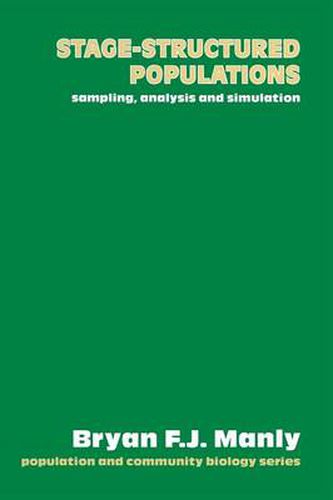
This book provides a review of methods for obtaining and analysing data from stage-structured biological populations. The topics covered are sam pling designs (Chapter 2), the estimation of parameters by maximum likelihood (Chapter 3), the analysis of sample counts of the numbers cif individuals in different stages at different times (Chapters 4 and 5), the analysis of data using Leslie matrix types of model (Chapter 6) and key factor analysis (Chapter 7). There is also some discussion of the approaches to modelling and estimation that have been used in five studies of particular populations (Chapter 8). There is a large literature on the modelling of biological populations, and a multitude of different approaches have been used in this area. The various approaches can be classified in different ways (Southwood, 1978, ch. 12), but for the purposes of this book it is convenient to think of the three categories mathematical, statistical and predictive modelling. Mathematical modelling is concerned largely with developing models that capture the most important qualitative features of population dynamics. In this case, the models that are developed do not have to be compared with data from natural populations. As representations of idealized systems, they can be quite informative in showing the effects of changing parameters, indicating what factors are most important in promoting stability, and so on.
$9.00 standard shipping within Australia
FREE standard shipping within Australia for orders over $100.00
Express & International shipping calculated at checkout
Stock availability can be subject to change without notice. We recommend calling the shop or contacting our online team to check availability of low stock items. Please see our Shopping Online page for more details.
This title is printed to order. This book may have been self-published. If so, we cannot guarantee the quality of the content. In the main most books will have gone through the editing process however some may not. We therefore suggest that you be aware of this before ordering this book. If in doubt check either the author or publisher’s details as we are unable to accept any returns unless they are faulty. Please contact us if you have any questions.
This book provides a review of methods for obtaining and analysing data from stage-structured biological populations. The topics covered are sam pling designs (Chapter 2), the estimation of parameters by maximum likelihood (Chapter 3), the analysis of sample counts of the numbers cif individuals in different stages at different times (Chapters 4 and 5), the analysis of data using Leslie matrix types of model (Chapter 6) and key factor analysis (Chapter 7). There is also some discussion of the approaches to modelling and estimation that have been used in five studies of particular populations (Chapter 8). There is a large literature on the modelling of biological populations, and a multitude of different approaches have been used in this area. The various approaches can be classified in different ways (Southwood, 1978, ch. 12), but for the purposes of this book it is convenient to think of the three categories mathematical, statistical and predictive modelling. Mathematical modelling is concerned largely with developing models that capture the most important qualitative features of population dynamics. In this case, the models that are developed do not have to be compared with data from natural populations. As representations of idealized systems, they can be quite informative in showing the effects of changing parameters, indicating what factors are most important in promoting stability, and so on.
Search our extensive online catalogue.
