Readings Newsletter
Become a Readings Member to make your shopping experience even easier.
Sign in or sign up for free!
You’re not far away from qualifying for FREE standard shipping within Australia
You’ve qualified for FREE standard shipping within Australia
The cart is loading…


This title is printed to order. This book may have been self-published. If so, we cannot guarantee the quality of the content. In the main most books will have gone through the editing process however some may not. We therefore suggest that you be aware of this before ordering this book. If in doubt check either the author or publisher’s details as we are unable to accept any returns unless they are faulty. Please contact us if you have any questions.
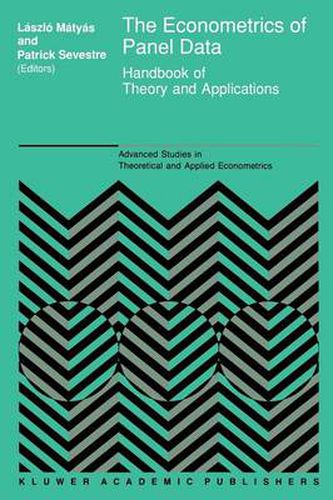
The aim of this volume is to provide a general overview of the econometrics of panel data, both from a theoretical and from an applied viewpoint. Since the pioneering papers by Kuh (1959), Mundlak (1961), Hoch (1962), and Balestra and Nerlove (1966), the pooling of cross section and time series data has become an increasingly popular way of quantifying economic relationships. Each series provides information lacking in the other, so a combination of both leads to more accurate and reliable results than would be achievable by one type of series alone. Over the last 30 years much work has been done: investigation of the properties of the applied estimators and test statistics, analysis of dynamic models and the effects of eventual measurement errors, etc. These are just some of the problems addressed by this work. In addition, some specific diffi culties associated with the use of panel data, such as attrition, heterogeneity, selectivity bias, pseudo panels etc., have also been explored. The first objective of this book, which takes up Parts I and II, is to give as complete and up-to-date a presentation of these theoretical developments as possible. Part I is concerned with classical linear models and their extensions; Part II deals with nonlinear models and related issues: logit and probit models, latent variable models, incomplete panels and selectivity bias, and point processes.
$9.00 standard shipping within Australia
FREE standard shipping within Australia for orders over $100.00
Express & International shipping calculated at checkout
Stock availability can be subject to change without notice. We recommend calling the shop or contacting our online team to check availability of low stock items. Please see our Shopping Online page for more details.
This title is printed to order. This book may have been self-published. If so, we cannot guarantee the quality of the content. In the main most books will have gone through the editing process however some may not. We therefore suggest that you be aware of this before ordering this book. If in doubt check either the author or publisher’s details as we are unable to accept any returns unless they are faulty. Please contact us if you have any questions.
The aim of this volume is to provide a general overview of the econometrics of panel data, both from a theoretical and from an applied viewpoint. Since the pioneering papers by Kuh (1959), Mundlak (1961), Hoch (1962), and Balestra and Nerlove (1966), the pooling of cross section and time series data has become an increasingly popular way of quantifying economic relationships. Each series provides information lacking in the other, so a combination of both leads to more accurate and reliable results than would be achievable by one type of series alone. Over the last 30 years much work has been done: investigation of the properties of the applied estimators and test statistics, analysis of dynamic models and the effects of eventual measurement errors, etc. These are just some of the problems addressed by this work. In addition, some specific diffi culties associated with the use of panel data, such as attrition, heterogeneity, selectivity bias, pseudo panels etc., have also been explored. The first objective of this book, which takes up Parts I and II, is to give as complete and up-to-date a presentation of these theoretical developments as possible. Part I is concerned with classical linear models and their extensions; Part II deals with nonlinear models and related issues: logit and probit models, latent variable models, incomplete panels and selectivity bias, and point processes.
Search our extensive online catalogue.
