Readings Newsletter
Become a Readings Member to make your shopping experience even easier.
Sign in or sign up for free!
You’re not far away from qualifying for FREE standard shipping within Australia
You’ve qualified for FREE standard shipping within Australia
The cart is loading…


This title is printed to order. This book may have been self-published. If so, we cannot guarantee the quality of the content. In the main most books will have gone through the editing process however some may not. We therefore suggest that you be aware of this before ordering this book. If in doubt check either the author or publisher’s details as we are unable to accept any returns unless they are faulty. Please contact us if you have any questions.
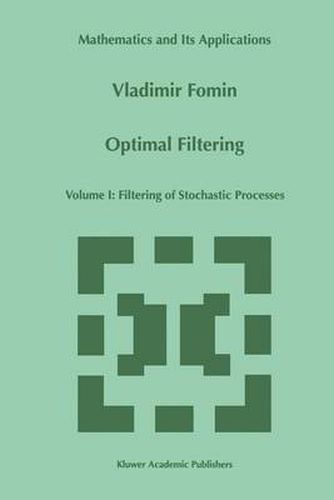
This book is devoted to an investigation of some important problems of mod ern filtering theory concerned with systems of ‘any nature being able to per ceive, store and process an information and apply it for control and regulation’. (The above quotation is taken from the preface to [27]). Despite the fact that filtering theory is l'argely worked out (and its major issues such as the Wiener-Kolmogorov theory of optimal filtering of stationary processes and Kalman-Bucy recursive filtering theory have become classical) a development of the theory is far from complete. A great deal of recent activity in this area is observed, researchers are trying consistently to generalize famous results, extend them to more broad classes of processes, realize and justify more simple procedures for processing measurement data in order to obtain more efficient filtering algorithms. As to nonlinear filter ing, it remains much as fragmentary. Here much progress has been made by R. L. Stratonovich and his successors in the area of filtering of Markov processes. In this volume an effort is made to advance in certain of these issues. The monograph has evolved over many years, coming of age by stages. First it was an impressive job of gathering together the bulk of the impor tant contributions to estimation theory, an understanding and moderniza tion of some of its results and methods, with the intention of applying them to recursive filtering problems.
$9.00 standard shipping within Australia
FREE standard shipping within Australia for orders over $100.00
Express & International shipping calculated at checkout
Stock availability can be subject to change without notice. We recommend calling the shop or contacting our online team to check availability of low stock items. Please see our Shopping Online page for more details.
This title is printed to order. This book may have been self-published. If so, we cannot guarantee the quality of the content. In the main most books will have gone through the editing process however some may not. We therefore suggest that you be aware of this before ordering this book. If in doubt check either the author or publisher’s details as we are unable to accept any returns unless they are faulty. Please contact us if you have any questions.
This book is devoted to an investigation of some important problems of mod ern filtering theory concerned with systems of ‘any nature being able to per ceive, store and process an information and apply it for control and regulation’. (The above quotation is taken from the preface to [27]). Despite the fact that filtering theory is l'argely worked out (and its major issues such as the Wiener-Kolmogorov theory of optimal filtering of stationary processes and Kalman-Bucy recursive filtering theory have become classical) a development of the theory is far from complete. A great deal of recent activity in this area is observed, researchers are trying consistently to generalize famous results, extend them to more broad classes of processes, realize and justify more simple procedures for processing measurement data in order to obtain more efficient filtering algorithms. As to nonlinear filter ing, it remains much as fragmentary. Here much progress has been made by R. L. Stratonovich and his successors in the area of filtering of Markov processes. In this volume an effort is made to advance in certain of these issues. The monograph has evolved over many years, coming of age by stages. First it was an impressive job of gathering together the bulk of the impor tant contributions to estimation theory, an understanding and moderniza tion of some of its results and methods, with the intention of applying them to recursive filtering problems.
Search our extensive online catalogue.
