Readings Newsletter
Become a Readings Member to make your shopping experience even easier.
Sign in or sign up for free!
You’re not far away from qualifying for FREE standard shipping within Australia
You’ve qualified for FREE standard shipping within Australia
The cart is loading…


This title is printed to order. This book may have been self-published. If so, we cannot guarantee the quality of the content. In the main most books will have gone through the editing process however some may not. We therefore suggest that you be aware of this before ordering this book. If in doubt check either the author or publisher’s details as we are unable to accept any returns unless they are faulty. Please contact us if you have any questions.
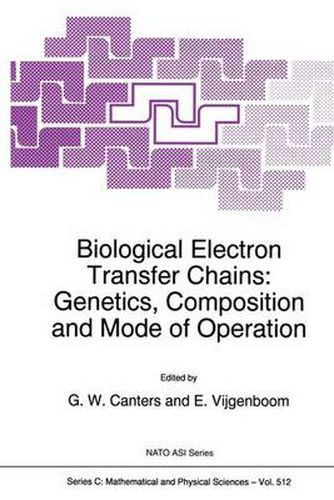
From May 3-7,1997, the NATO Advanced Research Workshop on ‘Biological Electron Transfer Chains’ was organized in Tomar, Portugal. In the application for support the choice of the topic was justified as follows: [Until recently efforts] have concentrated on the study of the structure and function of individual redox enzymes and proteins. Enough information is now available to make a start with the study of biological electron transfer (E1) at the next higher level of organization, that of the complete ET chain. The interest in the workshop was high: the majority of participants had registered before the workshop was formally announced, which illustrates the popularity of the topic within the biochemical and biophysical communities. The present volume contains a number of reports based on the lectures presented by the key speakers during the meeting. The workshop dealt with the following three themes: a) Electron transfer, which is the subject of Chapter 1. The analysis of ET at the molecular level is still fundamental for an understanding of how ET chains operate in vivo. After 40 years of research the contours of the subject are becoming clear now. b) Bacterial redox chains. This is the subject of Chapter 2. Its contents show how complicated these chains can be, often involving a number of gene clusters. Our understanding of the regulatory aspects and control mechanisms of these chains is only in its beginning.
$9.00 standard shipping within Australia
FREE standard shipping within Australia for orders over $100.00
Express & International shipping calculated at checkout
Stock availability can be subject to change without notice. We recommend calling the shop or contacting our online team to check availability of low stock items. Please see our Shopping Online page for more details.
This title is printed to order. This book may have been self-published. If so, we cannot guarantee the quality of the content. In the main most books will have gone through the editing process however some may not. We therefore suggest that you be aware of this before ordering this book. If in doubt check either the author or publisher’s details as we are unable to accept any returns unless they are faulty. Please contact us if you have any questions.
From May 3-7,1997, the NATO Advanced Research Workshop on ‘Biological Electron Transfer Chains’ was organized in Tomar, Portugal. In the application for support the choice of the topic was justified as follows: [Until recently efforts] have concentrated on the study of the structure and function of individual redox enzymes and proteins. Enough information is now available to make a start with the study of biological electron transfer (E1) at the next higher level of organization, that of the complete ET chain. The interest in the workshop was high: the majority of participants had registered before the workshop was formally announced, which illustrates the popularity of the topic within the biochemical and biophysical communities. The present volume contains a number of reports based on the lectures presented by the key speakers during the meeting. The workshop dealt with the following three themes: a) Electron transfer, which is the subject of Chapter 1. The analysis of ET at the molecular level is still fundamental for an understanding of how ET chains operate in vivo. After 40 years of research the contours of the subject are becoming clear now. b) Bacterial redox chains. This is the subject of Chapter 2. Its contents show how complicated these chains can be, often involving a number of gene clusters. Our understanding of the regulatory aspects and control mechanisms of these chains is only in its beginning.
Search our extensive online catalogue.
