Readings Newsletter
Become a Readings Member to make your shopping experience even easier.
Sign in or sign up for free!
You’re not far away from qualifying for FREE standard shipping within Australia
You’ve qualified for FREE standard shipping within Australia
The cart is loading…


This title is printed to order. This book may have been self-published. If so, we cannot guarantee the quality of the content. In the main most books will have gone through the editing process however some may not. We therefore suggest that you be aware of this before ordering this book. If in doubt check either the author or publisher’s details as we are unable to accept any returns unless they are faulty. Please contact us if you have any questions.
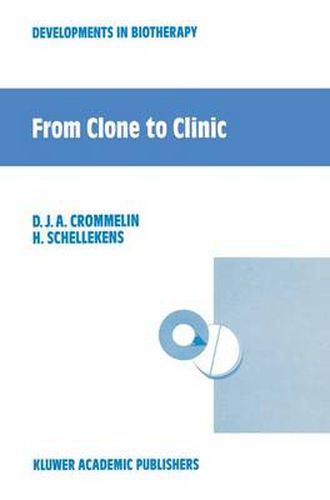
This book contains a selection of the papers presented at the meeting Between Clone and Clinic which was organised in March 1990 in Amsterdam by the dutch Organisation for Applied Research, TNO, and the University of Utrecht. The scope of this meeting was the development of biotechnological pharmaceuticals mainly made by recombinant DNA technology or monoclonal antibody techniques. All aspects concerning the development of the products after host cells producing them are obtained where discussed. The meeting was attended by twohundred specialists from all over the globe, including phar macologists, toxicologists, registration experts, Quality Assurence managers, production en gineers and physicians. Biotechnological pharmaceuticals are in general large and complex protein molecules. Bringing these products to the market poses other problems than encountered with the classical chemical drugs. The source of biotechnological pharmaceuticals are living cells. The function of cells are depend ent on many factors and the stability of production may be a problem. Good Laboratory and Manufactory Practices with Quality Control (GLP and GMP) are of paramount importance and are discussed in a number of papers. The products of the new biotechnology are often highly specific and only active in the human species. Also the side effects can only be studied in the clinical setting. Even when the product is active in animals there is the problem of antigenicity. During treatment the animals will produce antibodies which neutralise the activity. So safety testing may prove difficult.
$9.00 standard shipping within Australia
FREE standard shipping within Australia for orders over $100.00
Express & International shipping calculated at checkout
Stock availability can be subject to change without notice. We recommend calling the shop or contacting our online team to check availability of low stock items. Please see our Shopping Online page for more details.
This title is printed to order. This book may have been self-published. If so, we cannot guarantee the quality of the content. In the main most books will have gone through the editing process however some may not. We therefore suggest that you be aware of this before ordering this book. If in doubt check either the author or publisher’s details as we are unable to accept any returns unless they are faulty. Please contact us if you have any questions.
This book contains a selection of the papers presented at the meeting Between Clone and Clinic which was organised in March 1990 in Amsterdam by the dutch Organisation for Applied Research, TNO, and the University of Utrecht. The scope of this meeting was the development of biotechnological pharmaceuticals mainly made by recombinant DNA technology or monoclonal antibody techniques. All aspects concerning the development of the products after host cells producing them are obtained where discussed. The meeting was attended by twohundred specialists from all over the globe, including phar macologists, toxicologists, registration experts, Quality Assurence managers, production en gineers and physicians. Biotechnological pharmaceuticals are in general large and complex protein molecules. Bringing these products to the market poses other problems than encountered with the classical chemical drugs. The source of biotechnological pharmaceuticals are living cells. The function of cells are depend ent on many factors and the stability of production may be a problem. Good Laboratory and Manufactory Practices with Quality Control (GLP and GMP) are of paramount importance and are discussed in a number of papers. The products of the new biotechnology are often highly specific and only active in the human species. Also the side effects can only be studied in the clinical setting. Even when the product is active in animals there is the problem of antigenicity. During treatment the animals will produce antibodies which neutralise the activity. So safety testing may prove difficult.
Search our extensive online catalogue.
