Readings Newsletter
Become a Readings Member to make your shopping experience even easier.
Sign in or sign up for free!
You’re not far away from qualifying for FREE standard shipping within Australia
You’ve qualified for FREE standard shipping within Australia
The cart is loading…


This title is printed to order. This book may have been self-published. If so, we cannot guarantee the quality of the content. In the main most books will have gone through the editing process however some may not. We therefore suggest that you be aware of this before ordering this book. If in doubt check either the author or publisher’s details as we are unable to accept any returns unless they are faulty. Please contact us if you have any questions.
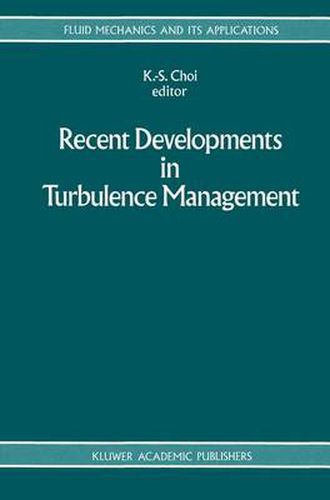
The European Drag Reduction Meeting has been held on 15th and 16th November 1990 in London. This was the fifth of the annual European meetings on drag reduction in engineering flows. The main objective of this meeting was to discuss up-to-date results of drag reduction research carried out in Europe. The organiser has adopted the philosophy of discussing the yesterday’s results rather than the last year’s results. No written material has therefore been requested for the meeting. It was only after the meeting the submission of papers was requested to the participants, from which 16 papers were selected for this proceedings volume. The meeting has attracted a record number of participants with a total of 52 researchers from seven European countries, U. K. , France, Germany, the Netherlands, Italy, Switzerland and U. S. S. R. as well as from Japan, Canada and Australia. The subjects covered in this proceedings volume include riblets, LEBUs (Large Eddy Break-Up device), surface roughness, compliant surfaces and polymer additives. Riblets seem to be one of the most extensively studied devices in the past years. Reflecting this situation in the European community, there are six papers on riblets covering their practical applications to aircraft and to a model ship, near-wall coherent structure of the boundary layer and effects of flow three-dimensionality. Possibility of heat-transfer enhancement with riblets and potential use in the laminar flow are also investigated. An analytical model is developed for the boundary-layer with a LEBU device.
$9.00 standard shipping within Australia
FREE standard shipping within Australia for orders over $100.00
Express & International shipping calculated at checkout
Stock availability can be subject to change without notice. We recommend calling the shop or contacting our online team to check availability of low stock items. Please see our Shopping Online page for more details.
This title is printed to order. This book may have been self-published. If so, we cannot guarantee the quality of the content. In the main most books will have gone through the editing process however some may not. We therefore suggest that you be aware of this before ordering this book. If in doubt check either the author or publisher’s details as we are unable to accept any returns unless they are faulty. Please contact us if you have any questions.
The European Drag Reduction Meeting has been held on 15th and 16th November 1990 in London. This was the fifth of the annual European meetings on drag reduction in engineering flows. The main objective of this meeting was to discuss up-to-date results of drag reduction research carried out in Europe. The organiser has adopted the philosophy of discussing the yesterday’s results rather than the last year’s results. No written material has therefore been requested for the meeting. It was only after the meeting the submission of papers was requested to the participants, from which 16 papers were selected for this proceedings volume. The meeting has attracted a record number of participants with a total of 52 researchers from seven European countries, U. K. , France, Germany, the Netherlands, Italy, Switzerland and U. S. S. R. as well as from Japan, Canada and Australia. The subjects covered in this proceedings volume include riblets, LEBUs (Large Eddy Break-Up device), surface roughness, compliant surfaces and polymer additives. Riblets seem to be one of the most extensively studied devices in the past years. Reflecting this situation in the European community, there are six papers on riblets covering their practical applications to aircraft and to a model ship, near-wall coherent structure of the boundary layer and effects of flow three-dimensionality. Possibility of heat-transfer enhancement with riblets and potential use in the laminar flow are also investigated. An analytical model is developed for the boundary-layer with a LEBU device.
Search our extensive online catalogue.
