Readings Newsletter
Become a Readings Member to make your shopping experience even easier.
Sign in or sign up for free!
You’re not far away from qualifying for FREE standard shipping within Australia
You’ve qualified for FREE standard shipping within Australia
The cart is loading…


This title is printed to order. This book may have been self-published. If so, we cannot guarantee the quality of the content. In the main most books will have gone through the editing process however some may not. We therefore suggest that you be aware of this before ordering this book. If in doubt check either the author or publisher’s details as we are unable to accept any returns unless they are faulty. Please contact us if you have any questions.
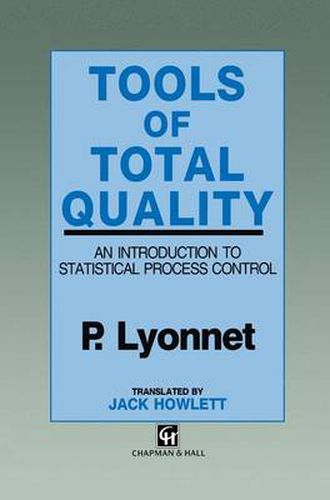
For a long time, quality has been one of industry’s main preoccupations. It remains so today. There is some foundation for the statement that there is a ‘quality crisis’ in Europe, the methods traditionally used in our industries being unable to meet today’s demands. Consequently it is essential to look for new directions in which to progress, taking account of the methods for achieving quality that have been developed in recent years. These methods impact on all parts of the industrial enterprise - marketing, manufacturing, research and development, after-sales services. All staff, administrative or technical, are involved. The present book describes the tools that can help anyone who is concerned with the concept of ‘total quality’; it will also be a valuable educational aid for students reading for degrees or other qualifications in engineering. P. Lyonnet I General questions and concepts 1 INTRODUCTION: HOW CAN WE ACHIEVE TOTAL QUALITY? This book is concerned with the various techniques and methods of analysis that can be used to ensure total quality in a project. In this first chapter we show the costs that result from not achieving quality, so as to make clear how important a quality-assurance service is to any enterprise. We stress also the involvement of marketing, particularly in laying down specifications for reliability.
$9.00 standard shipping within Australia
FREE standard shipping within Australia for orders over $100.00
Express & International shipping calculated at checkout
Stock availability can be subject to change without notice. We recommend calling the shop or contacting our online team to check availability of low stock items. Please see our Shopping Online page for more details.
This title is printed to order. This book may have been self-published. If so, we cannot guarantee the quality of the content. In the main most books will have gone through the editing process however some may not. We therefore suggest that you be aware of this before ordering this book. If in doubt check either the author or publisher’s details as we are unable to accept any returns unless they are faulty. Please contact us if you have any questions.
For a long time, quality has been one of industry’s main preoccupations. It remains so today. There is some foundation for the statement that there is a ‘quality crisis’ in Europe, the methods traditionally used in our industries being unable to meet today’s demands. Consequently it is essential to look for new directions in which to progress, taking account of the methods for achieving quality that have been developed in recent years. These methods impact on all parts of the industrial enterprise - marketing, manufacturing, research and development, after-sales services. All staff, administrative or technical, are involved. The present book describes the tools that can help anyone who is concerned with the concept of ‘total quality’; it will also be a valuable educational aid for students reading for degrees or other qualifications in engineering. P. Lyonnet I General questions and concepts 1 INTRODUCTION: HOW CAN WE ACHIEVE TOTAL QUALITY? This book is concerned with the various techniques and methods of analysis that can be used to ensure total quality in a project. In this first chapter we show the costs that result from not achieving quality, so as to make clear how important a quality-assurance service is to any enterprise. We stress also the involvement of marketing, particularly in laying down specifications for reliability.
Search our extensive online catalogue.
