Readings Newsletter
Become a Readings Member to make your shopping experience even easier.
Sign in or sign up for free!
You’re not far away from qualifying for FREE standard shipping within Australia
You’ve qualified for FREE standard shipping within Australia
The cart is loading…


This title is printed to order. This book may have been self-published. If so, we cannot guarantee the quality of the content. In the main most books will have gone through the editing process however some may not. We therefore suggest that you be aware of this before ordering this book. If in doubt check either the author or publisher’s details as we are unable to accept any returns unless they are faulty. Please contact us if you have any questions.
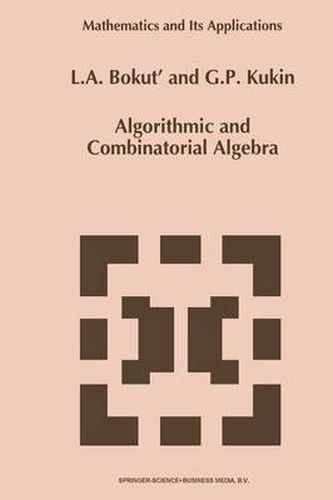
Even three decades ago, the words ‘combinatorial algebra’ contrasting, for in stance, the words ‘combinatorial topology,’ were not a common designation for some branch of mathematics. The collocation ‘combinatorial group theory’ seems to ap pear first as the title of the book by A. Karras, W. Magnus, and D. Solitar [182] and, later on, it served as the title of the book by R. C. Lyndon and P. Schupp [247]. Nowadays, specialists do not question the existence of ‘combinatorial algebra’ as a special algebraic activity. The activity is distinguished not only by its objects of research (that are effectively given to some extent) but also by its methods (ef fective to some extent). To be more exact, we could approximately define the term ‘combinatorial algebra’ for the purposes of this book, as follows: So we call a part of algebra dealing with groups, semi groups , associative algebras, Lie algebras, and other algebraic systems which are given by generators and defining relations {in the first and particular place, free groups, semigroups, algebras, etc. )j a part in which we study universal constructions, viz. free products, lINN-extensions, etc. j and, finally, a part where specific methods such as the Composition Method (in other words, the Diamond Lemma, see [49]) are applied. Surely, the above explanation is far from covering the full scope of the term (compare the prefaces to the books mentioned above).
$9.00 standard shipping within Australia
FREE standard shipping within Australia for orders over $100.00
Express & International shipping calculated at checkout
Stock availability can be subject to change without notice. We recommend calling the shop or contacting our online team to check availability of low stock items. Please see our Shopping Online page for more details.
This title is printed to order. This book may have been self-published. If so, we cannot guarantee the quality of the content. In the main most books will have gone through the editing process however some may not. We therefore suggest that you be aware of this before ordering this book. If in doubt check either the author or publisher’s details as we are unable to accept any returns unless they are faulty. Please contact us if you have any questions.
Even three decades ago, the words ‘combinatorial algebra’ contrasting, for in stance, the words ‘combinatorial topology,’ were not a common designation for some branch of mathematics. The collocation ‘combinatorial group theory’ seems to ap pear first as the title of the book by A. Karras, W. Magnus, and D. Solitar [182] and, later on, it served as the title of the book by R. C. Lyndon and P. Schupp [247]. Nowadays, specialists do not question the existence of ‘combinatorial algebra’ as a special algebraic activity. The activity is distinguished not only by its objects of research (that are effectively given to some extent) but also by its methods (ef fective to some extent). To be more exact, we could approximately define the term ‘combinatorial algebra’ for the purposes of this book, as follows: So we call a part of algebra dealing with groups, semi groups , associative algebras, Lie algebras, and other algebraic systems which are given by generators and defining relations {in the first and particular place, free groups, semigroups, algebras, etc. )j a part in which we study universal constructions, viz. free products, lINN-extensions, etc. j and, finally, a part where specific methods such as the Composition Method (in other words, the Diamond Lemma, see [49]) are applied. Surely, the above explanation is far from covering the full scope of the term (compare the prefaces to the books mentioned above).
Search our extensive online catalogue.
