Readings Newsletter
Become a Readings Member to make your shopping experience even easier.
Sign in or sign up for free!
You’re not far away from qualifying for FREE standard shipping within Australia
You’ve qualified for FREE standard shipping within Australia
The cart is loading…


This title is printed to order. This book may have been self-published. If so, we cannot guarantee the quality of the content. In the main most books will have gone through the editing process however some may not. We therefore suggest that you be aware of this before ordering this book. If in doubt check either the author or publisher’s details as we are unable to accept any returns unless they are faulty. Please contact us if you have any questions.
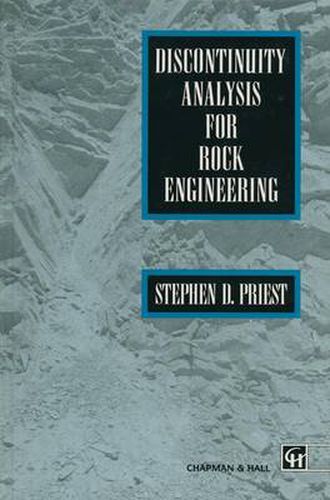
Engineers wishing to build structures on or in rock use the discipline known as rock mechanics. This discipline emerged as a subject in its own right about thirty five years ago, and has developed rapidly ever since. However, rock mechanics is still based to a large extent on analytical techniques that were originally formulated for the mechanical design of structures made from man made materials. The single most important distinction between man-made materials and the natural material rock is that rock contains fractures, of many kinds on many scales; and because the fractures - of whatever kin- represent breaks in the mechanical continuum, they are collectively termed ‘discontinuities’ . An understanding of the mechanical influence of these discontinuities is essential to all rock engineers. Most of the world is made of rock, and most of the rock near the surface is fractured. The fractures dominate the rock mass geometry, deformation modulus, strength, failure behaviour, permeability, and even the local magnitudes and directions of the in situ stress field. Clearly, an understanding of the presence and mechanics of the discontinuities, both singly and in the rock mass context, is therefore of paramount importance to civil, mining and petroleum engineers. Bearing this in mind, it is surprising that until now there has been no book dedicated specifically to the subject of discontinuity analysis in rock engineering.
$9.00 standard shipping within Australia
FREE standard shipping within Australia for orders over $100.00
Express & International shipping calculated at checkout
Stock availability can be subject to change without notice. We recommend calling the shop or contacting our online team to check availability of low stock items. Please see our Shopping Online page for more details.
This title is printed to order. This book may have been self-published. If so, we cannot guarantee the quality of the content. In the main most books will have gone through the editing process however some may not. We therefore suggest that you be aware of this before ordering this book. If in doubt check either the author or publisher’s details as we are unable to accept any returns unless they are faulty. Please contact us if you have any questions.
Engineers wishing to build structures on or in rock use the discipline known as rock mechanics. This discipline emerged as a subject in its own right about thirty five years ago, and has developed rapidly ever since. However, rock mechanics is still based to a large extent on analytical techniques that were originally formulated for the mechanical design of structures made from man made materials. The single most important distinction between man-made materials and the natural material rock is that rock contains fractures, of many kinds on many scales; and because the fractures - of whatever kin- represent breaks in the mechanical continuum, they are collectively termed ‘discontinuities’ . An understanding of the mechanical influence of these discontinuities is essential to all rock engineers. Most of the world is made of rock, and most of the rock near the surface is fractured. The fractures dominate the rock mass geometry, deformation modulus, strength, failure behaviour, permeability, and even the local magnitudes and directions of the in situ stress field. Clearly, an understanding of the presence and mechanics of the discontinuities, both singly and in the rock mass context, is therefore of paramount importance to civil, mining and petroleum engineers. Bearing this in mind, it is surprising that until now there has been no book dedicated specifically to the subject of discontinuity analysis in rock engineering.
Search our extensive online catalogue.
