Readings Newsletter
Become a Readings Member to make your shopping experience even easier.
Sign in or sign up for free!
You’re not far away from qualifying for FREE standard shipping within Australia
You’ve qualified for FREE standard shipping within Australia
The cart is loading…


This title is printed to order. This book may have been self-published. If so, we cannot guarantee the quality of the content. In the main most books will have gone through the editing process however some may not. We therefore suggest that you be aware of this before ordering this book. If in doubt check either the author or publisher’s details as we are unable to accept any returns unless they are faulty. Please contact us if you have any questions.
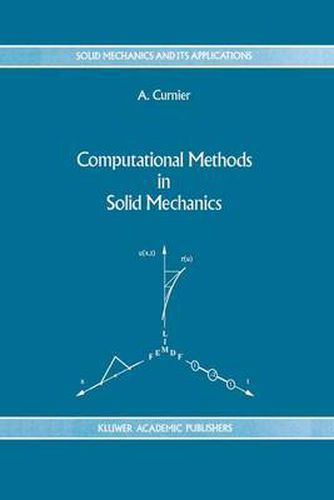
Summary This bookis an introdU(;tion to the three numerical methodsmost commonly used for the mechanical analysisof deformable solids, namely: * the finite element method(FEM), a particularcaseofGalerkin’s method, for the spatial discretisationofsolids; * the linear iteration method(LIM), a generalizationofNewton’s method, for solving geometricandmaterial nonlinearities; * the finite difference method (FDM), in fact Newmark’s method, for the temporal discretisation oftheproblem. The main reason for this selection is the degree of generality reached by the computerprograms basedon the combinationofthese methods. The originalityofthepresentation lies in the comparable emphasisputon the spatial, temporal and nonlinear dimensions of problem solving. For each dimension, there corresponds one method whose basic principle is exposed. It is then shown how they can be combined in a compact and flexible fonn. Thisjoint investigationofthe three methods leads to a particularly neat global algorithm. It is with this double objectiveof simplicity and unity in mind that this book has been designed. An outline of the book follows. A one-dimensional bar model problem, including all the ingredients necessary for acompletepresentationofthe addressed methods, isdefined in Chapter1. Emphasis is placedon the virtual work principle as an alternative to the.differentialequation ofmotion. Chapters 2, 3 and 4 present the three numerical methods: FEM, LIM and FDM, respectively. Although the presentation relies on a one-dimensional model problem, the fonnalism used is general and directly extendible to two- and three-dimensional situations. The compact combination of the three methods is discussed in detail in Chapter 5, which also contains several sections concerning their computer implementation.
$9.00 standard shipping within Australia
FREE standard shipping within Australia for orders over $100.00
Express & International shipping calculated at checkout
Stock availability can be subject to change without notice. We recommend calling the shop or contacting our online team to check availability of low stock items. Please see our Shopping Online page for more details.
This title is printed to order. This book may have been self-published. If so, we cannot guarantee the quality of the content. In the main most books will have gone through the editing process however some may not. We therefore suggest that you be aware of this before ordering this book. If in doubt check either the author or publisher’s details as we are unable to accept any returns unless they are faulty. Please contact us if you have any questions.
Summary This bookis an introdU(;tion to the three numerical methodsmost commonly used for the mechanical analysisof deformable solids, namely: * the finite element method(FEM), a particularcaseofGalerkin’s method, for the spatial discretisationofsolids; * the linear iteration method(LIM), a generalizationofNewton’s method, for solving geometricandmaterial nonlinearities; * the finite difference method (FDM), in fact Newmark’s method, for the temporal discretisation oftheproblem. The main reason for this selection is the degree of generality reached by the computerprograms basedon the combinationofthese methods. The originalityofthepresentation lies in the comparable emphasisputon the spatial, temporal and nonlinear dimensions of problem solving. For each dimension, there corresponds one method whose basic principle is exposed. It is then shown how they can be combined in a compact and flexible fonn. Thisjoint investigationofthe three methods leads to a particularly neat global algorithm. It is with this double objectiveof simplicity and unity in mind that this book has been designed. An outline of the book follows. A one-dimensional bar model problem, including all the ingredients necessary for acompletepresentationofthe addressed methods, isdefined in Chapter1. Emphasis is placedon the virtual work principle as an alternative to the.differentialequation ofmotion. Chapters 2, 3 and 4 present the three numerical methods: FEM, LIM and FDM, respectively. Although the presentation relies on a one-dimensional model problem, the fonnalism used is general and directly extendible to two- and three-dimensional situations. The compact combination of the three methods is discussed in detail in Chapter 5, which also contains several sections concerning their computer implementation.
Search our extensive online catalogue.
