Readings Newsletter
Become a Readings Member to make your shopping experience even easier.
Sign in or sign up for free!
You’re not far away from qualifying for FREE standard shipping within Australia
You’ve qualified for FREE standard shipping within Australia
The cart is loading…


This title is printed to order. This book may have been self-published. If so, we cannot guarantee the quality of the content. In the main most books will have gone through the editing process however some may not. We therefore suggest that you be aware of this before ordering this book. If in doubt check either the author or publisher’s details as we are unable to accept any returns unless they are faulty. Please contact us if you have any questions.
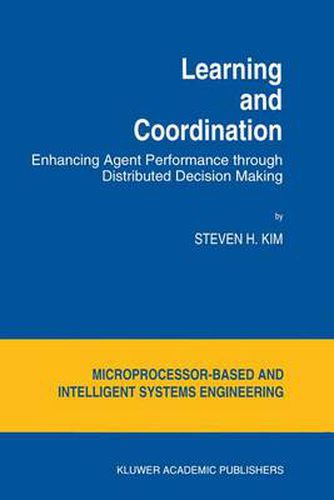
Intelligent systems of the natural kind are adaptive and robust: they learn over time and degrade gracefully under stress. If artificial systems are to display a similar level of sophistication, an organizing framework and operating principles are required to manage the resulting complexity of design and behavior.
This book presents a general framework for adaptive systems. The utility of the comprehensive framework is demonstrated by tailoring it to particular models of computational learning, ranging from neural networks to declarative logic.
The key to robustness lies in distributed decision making. An exemplar of this strategy is the neural network in both its biological and synthetic forms. In a neural network, the knowledge is encoded in the collection of cells and their linkages, rather than in any single component. Distributed decision making is even more apparent in the case of independent agents. For a population of autonomous agents, their proper coordination may well be more instrumental for attaining their objectives than are their individual capabilities.
This book probes the problems and opportunities arising from autonomous agents acting individually and collectively. Following the general framework for learning systems and its application to neural networks, the coordination of independent agents through game theory is explored. Finally, the utility of game theory for artificial agents is revealed through a case study in robotic coordination.
Given the universality of the subjects – learning behavior and coordinative strategies in uncertain environments – this book will be of interest to students and researchers in various disciplines, ranging from all areas of engineering to the computing disciplines; from the life sciences to the physical sciences; and from the management arts to social studies.
$9.00 standard shipping within Australia
FREE standard shipping within Australia for orders over $100.00
Express & International shipping calculated at checkout
Stock availability can be subject to change without notice. We recommend calling the shop or contacting our online team to check availability of low stock items. Please see our Shopping Online page for more details.
This title is printed to order. This book may have been self-published. If so, we cannot guarantee the quality of the content. In the main most books will have gone through the editing process however some may not. We therefore suggest that you be aware of this before ordering this book. If in doubt check either the author or publisher’s details as we are unable to accept any returns unless they are faulty. Please contact us if you have any questions.
Intelligent systems of the natural kind are adaptive and robust: they learn over time and degrade gracefully under stress. If artificial systems are to display a similar level of sophistication, an organizing framework and operating principles are required to manage the resulting complexity of design and behavior.
This book presents a general framework for adaptive systems. The utility of the comprehensive framework is demonstrated by tailoring it to particular models of computational learning, ranging from neural networks to declarative logic.
The key to robustness lies in distributed decision making. An exemplar of this strategy is the neural network in both its biological and synthetic forms. In a neural network, the knowledge is encoded in the collection of cells and their linkages, rather than in any single component. Distributed decision making is even more apparent in the case of independent agents. For a population of autonomous agents, their proper coordination may well be more instrumental for attaining their objectives than are their individual capabilities.
This book probes the problems and opportunities arising from autonomous agents acting individually and collectively. Following the general framework for learning systems and its application to neural networks, the coordination of independent agents through game theory is explored. Finally, the utility of game theory for artificial agents is revealed through a case study in robotic coordination.
Given the universality of the subjects – learning behavior and coordinative strategies in uncertain environments – this book will be of interest to students and researchers in various disciplines, ranging from all areas of engineering to the computing disciplines; from the life sciences to the physical sciences; and from the management arts to social studies.
Search our extensive online catalogue.
