Readings Newsletter
Become a Readings Member to make your shopping experience even easier.
Sign in or sign up for free!
You’re not far away from qualifying for FREE standard shipping within Australia
You’ve qualified for FREE standard shipping within Australia
The cart is loading…


This title is printed to order. This book may have been self-published. If so, we cannot guarantee the quality of the content. In the main most books will have gone through the editing process however some may not. We therefore suggest that you be aware of this before ordering this book. If in doubt check either the author or publisher’s details as we are unable to accept any returns unless they are faulty. Please contact us if you have any questions.
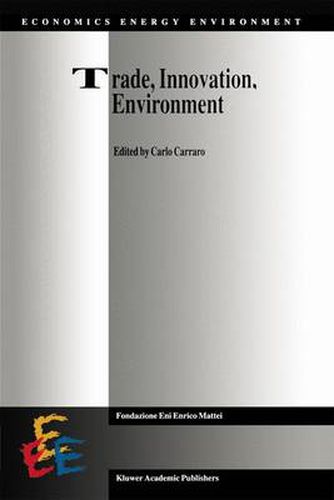
The research projects at Fondazione Mattei have for some time now been dealing with the international dimension of environmental policy. Indeed, most environ mental phenomena have international implications, which stem from a number of factors: physical ones, such as the transnational or global consequences of pollution and resource conservation; technological factors, such as technological cooperation and diffusion; and economic factors, such as trad~, plant localiza tion and migrations. Even in the absence of transnational pollution, therefore, the environmental issues involve substantial interdependence among countries. This volume, edited by Carlo Carraro, presents some of the research which we carried out in international environmental policy, focusing on the relationship between trade, innovation and the environment. The papers in part one discuss the impact of international trade and institu tions on environmental resources. Those in part two deal with the importance of innovation when attempting to solve the major environmental problems. The papers in part three, finally, focus on specific policy issues stressing the impor tance of institutions and property rights. The whole set of contributions can be seen as progress in environmental economics. The different chapters highlight the close relationship between envi ronmental issues and economic development and they merge the literature on the environment with the literature on innovation, economic growth, trade, plant localization, institutions, etc.
$9.00 standard shipping within Australia
FREE standard shipping within Australia for orders over $100.00
Express & International shipping calculated at checkout
Stock availability can be subject to change without notice. We recommend calling the shop or contacting our online team to check availability of low stock items. Please see our Shopping Online page for more details.
This title is printed to order. This book may have been self-published. If so, we cannot guarantee the quality of the content. In the main most books will have gone through the editing process however some may not. We therefore suggest that you be aware of this before ordering this book. If in doubt check either the author or publisher’s details as we are unable to accept any returns unless they are faulty. Please contact us if you have any questions.
The research projects at Fondazione Mattei have for some time now been dealing with the international dimension of environmental policy. Indeed, most environ mental phenomena have international implications, which stem from a number of factors: physical ones, such as the transnational or global consequences of pollution and resource conservation; technological factors, such as technological cooperation and diffusion; and economic factors, such as trad~, plant localiza tion and migrations. Even in the absence of transnational pollution, therefore, the environmental issues involve substantial interdependence among countries. This volume, edited by Carlo Carraro, presents some of the research which we carried out in international environmental policy, focusing on the relationship between trade, innovation and the environment. The papers in part one discuss the impact of international trade and institu tions on environmental resources. Those in part two deal with the importance of innovation when attempting to solve the major environmental problems. The papers in part three, finally, focus on specific policy issues stressing the impor tance of institutions and property rights. The whole set of contributions can be seen as progress in environmental economics. The different chapters highlight the close relationship between envi ronmental issues and economic development and they merge the literature on the environment with the literature on innovation, economic growth, trade, plant localization, institutions, etc.
Search our extensive online catalogue.
