Readings Newsletter
Become a Readings Member to make your shopping experience even easier.
Sign in or sign up for free!
You’re not far away from qualifying for FREE standard shipping within Australia
You’ve qualified for FREE standard shipping within Australia
The cart is loading…


This title is printed to order. This book may have been self-published. If so, we cannot guarantee the quality of the content. In the main most books will have gone through the editing process however some may not. We therefore suggest that you be aware of this before ordering this book. If in doubt check either the author or publisher’s details as we are unable to accept any returns unless they are faulty. Please contact us if you have any questions.
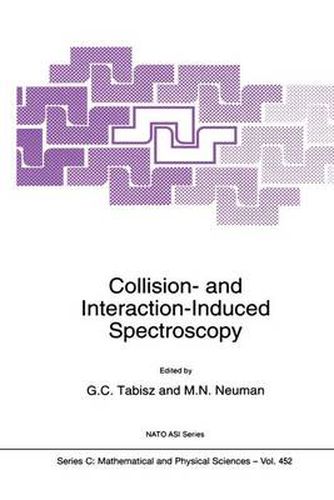
Collision-or interaction-induced spectroscopy refers to radiative transitions, which are forbidden in free atoms or molecules, but which occur in clusters of interacting atoms or molecules. The most common phenomena are induced absorption, in the infrared region, and induced light scattering, which involves inelastic scattering of visible laser light. The particle interactions giving rise to the necessary induced dipole moments and polarizabilities are modelled at long range by multipole expansions; at short range, electron overlap and exchange mechanisms come into play. Information on atomic and molecular interactions and dynamics in dense media on a picosecond timescale may be drawn from the spectra. Collision-induced absorption in the infrared was discovered at the University of Toronto in 1949 by Crawford, Welsh and Locke who studied liquid O and N. Through the 1950s and 1960s, 2 2 experimental elucidation of the phenomenon, particularly in gases, continued and theoretical underpinnings were established. In the late 1960s, the related phenomenon of collision-induced light scattering was first observed in compressed inert gases. In 1978, an ‘Enrico Fermi’ Summer School was held at Varenna, Italy, under the directorship of J. Van Kranendonk. The lectures, there, reviewed activity from the previous two decades, during which the approach to the subject had not changed greatly. In 1983, a highly successful NATO Advanced Research Workshop was held at Bonas, France, under the directorship of G. Birnbaum. An important outcome of that meeting was the demonstration of the maturity and sophistication of current experimental and theoretical techniques.
$9.00 standard shipping within Australia
FREE standard shipping within Australia for orders over $100.00
Express & International shipping calculated at checkout
Stock availability can be subject to change without notice. We recommend calling the shop or contacting our online team to check availability of low stock items. Please see our Shopping Online page for more details.
This title is printed to order. This book may have been self-published. If so, we cannot guarantee the quality of the content. In the main most books will have gone through the editing process however some may not. We therefore suggest that you be aware of this before ordering this book. If in doubt check either the author or publisher’s details as we are unable to accept any returns unless they are faulty. Please contact us if you have any questions.
Collision-or interaction-induced spectroscopy refers to radiative transitions, which are forbidden in free atoms or molecules, but which occur in clusters of interacting atoms or molecules. The most common phenomena are induced absorption, in the infrared region, and induced light scattering, which involves inelastic scattering of visible laser light. The particle interactions giving rise to the necessary induced dipole moments and polarizabilities are modelled at long range by multipole expansions; at short range, electron overlap and exchange mechanisms come into play. Information on atomic and molecular interactions and dynamics in dense media on a picosecond timescale may be drawn from the spectra. Collision-induced absorption in the infrared was discovered at the University of Toronto in 1949 by Crawford, Welsh and Locke who studied liquid O and N. Through the 1950s and 1960s, 2 2 experimental elucidation of the phenomenon, particularly in gases, continued and theoretical underpinnings were established. In the late 1960s, the related phenomenon of collision-induced light scattering was first observed in compressed inert gases. In 1978, an ‘Enrico Fermi’ Summer School was held at Varenna, Italy, under the directorship of J. Van Kranendonk. The lectures, there, reviewed activity from the previous two decades, during which the approach to the subject had not changed greatly. In 1983, a highly successful NATO Advanced Research Workshop was held at Bonas, France, under the directorship of G. Birnbaum. An important outcome of that meeting was the demonstration of the maturity and sophistication of current experimental and theoretical techniques.
Search our extensive online catalogue.
