Readings Newsletter
Become a Readings Member to make your shopping experience even easier.
Sign in or sign up for free!
You’re not far away from qualifying for FREE standard shipping within Australia
You’ve qualified for FREE standard shipping within Australia
The cart is loading…


This title is printed to order. This book may have been self-published. If so, we cannot guarantee the quality of the content. In the main most books will have gone through the editing process however some may not. We therefore suggest that you be aware of this before ordering this book. If in doubt check either the author or publisher’s details as we are unable to accept any returns unless they are faulty. Please contact us if you have any questions.
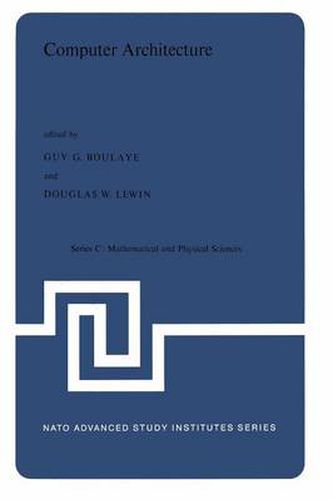
This book presents as formal papers nearly all of the lectures given at the NATO advanced summer institute on Computer Architecture held at St. Raphael, France from September 12th - 24th 1976. It was not possible to include an important paper by G. Amdahl on the 470V6 System, nor papers by Mde. A. Recoque on distributed processing, Messrs. A. Maison and G. Debruyne on LSI technology, and K. Bowden. Computer architecture is a very diverse and expanding subject, consequently it was decided to limit the scope of the School to five main subject areas. These were: specific computer architectures, language orientated machines, associative processing, computer networks and specification and design methods. In addition an overall emphasis was placed on distributed and parallel processing and the need for an integrated hardware-software approach to design. Though some introductory material is included, this book is primarily intended for workers in the field of computer science and engineering who wish to update themselves on current topics in computer architecture. The main work of the School is well reflected in the collected papers, but it is impossible to convey the benefits obtained from the discussion groups and the continuous dialogue that was maintained throughout the School. The Editors would like to acknowledge with thanks the support of the NATO Scientific Affairs Division, who financed the School, and the European Research Office of the U.S. Army and the National Science Foundation for providing travel grants.
$9.00 standard shipping within Australia
FREE standard shipping within Australia for orders over $100.00
Express & International shipping calculated at checkout
Stock availability can be subject to change without notice. We recommend calling the shop or contacting our online team to check availability of low stock items. Please see our Shopping Online page for more details.
This title is printed to order. This book may have been self-published. If so, we cannot guarantee the quality of the content. In the main most books will have gone through the editing process however some may not. We therefore suggest that you be aware of this before ordering this book. If in doubt check either the author or publisher’s details as we are unable to accept any returns unless they are faulty. Please contact us if you have any questions.
This book presents as formal papers nearly all of the lectures given at the NATO advanced summer institute on Computer Architecture held at St. Raphael, France from September 12th - 24th 1976. It was not possible to include an important paper by G. Amdahl on the 470V6 System, nor papers by Mde. A. Recoque on distributed processing, Messrs. A. Maison and G. Debruyne on LSI technology, and K. Bowden. Computer architecture is a very diverse and expanding subject, consequently it was decided to limit the scope of the School to five main subject areas. These were: specific computer architectures, language orientated machines, associative processing, computer networks and specification and design methods. In addition an overall emphasis was placed on distributed and parallel processing and the need for an integrated hardware-software approach to design. Though some introductory material is included, this book is primarily intended for workers in the field of computer science and engineering who wish to update themselves on current topics in computer architecture. The main work of the School is well reflected in the collected papers, but it is impossible to convey the benefits obtained from the discussion groups and the continuous dialogue that was maintained throughout the School. The Editors would like to acknowledge with thanks the support of the NATO Scientific Affairs Division, who financed the School, and the European Research Office of the U.S. Army and the National Science Foundation for providing travel grants.
Search our extensive online catalogue.
