Readings Newsletter
Become a Readings Member to make your shopping experience even easier.
Sign in or sign up for free!
You’re not far away from qualifying for FREE standard shipping within Australia
You’ve qualified for FREE standard shipping within Australia
The cart is loading…


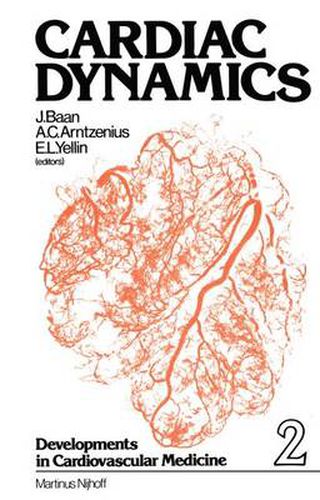
Cardiac Dynamics is the name of a relatively young field of study, born from the fruitful interaction between branches of two different disciplines: medicine and physics. Dynamics is the branch of physics which deals with the action of forces on bodies or particles in motion or at rest. Cardiac relates to the clinical field of cardiology but also to cardiophysiology, both of which are specialized branches of medicine. Narrower than the well established field of Hemodynamics, Cardiac Dynamics is restricted to dynamic phenomena occurring in and around the heart. The mathematical treatment of such phenomena, however, is vastly more complex because of the intricate nature of the mechanisms involved in the cardiac action. Thus, whereas hemodynamics is concerned with predominantly passive (visco-) elastic structures - vessels - containing time-variant flow of viscous flui- blood -, the mechanical study of the heart requires additional con siderations such as: active elastic components representing the contractile mechanism of cardiac muscle, complex geometry and fiber structure in the myocardial wall, autoregulatory mechanisms, and intricate flow patterns associated with valve motion. Viewed in this light it is not surprising that attempts to describe ventricular pump function and to quantify contractile performance have not reached the level of sophistication which is common in e. g. arterial hemodynamics. For the same reason, many of the often simplified approaches to describe ventricular mechanics failed to stand up to more rigorous theoretical, experimental or clinical testing.
$9.00 standard shipping within Australia
FREE standard shipping within Australia for orders over $100.00
Express & International shipping calculated at checkout
Stock availability can be subject to change without notice. We recommend calling the shop or contacting our online team to check availability of low stock items. Please see our Shopping Online page for more details.
Cardiac Dynamics is the name of a relatively young field of study, born from the fruitful interaction between branches of two different disciplines: medicine and physics. Dynamics is the branch of physics which deals with the action of forces on bodies or particles in motion or at rest. Cardiac relates to the clinical field of cardiology but also to cardiophysiology, both of which are specialized branches of medicine. Narrower than the well established field of Hemodynamics, Cardiac Dynamics is restricted to dynamic phenomena occurring in and around the heart. The mathematical treatment of such phenomena, however, is vastly more complex because of the intricate nature of the mechanisms involved in the cardiac action. Thus, whereas hemodynamics is concerned with predominantly passive (visco-) elastic structures - vessels - containing time-variant flow of viscous flui- blood -, the mechanical study of the heart requires additional con siderations such as: active elastic components representing the contractile mechanism of cardiac muscle, complex geometry and fiber structure in the myocardial wall, autoregulatory mechanisms, and intricate flow patterns associated with valve motion. Viewed in this light it is not surprising that attempts to describe ventricular pump function and to quantify contractile performance have not reached the level of sophistication which is common in e. g. arterial hemodynamics. For the same reason, many of the often simplified approaches to describe ventricular mechanics failed to stand up to more rigorous theoretical, experimental or clinical testing.
Search our extensive online catalogue.
