Readings Newsletter
Become a Readings Member to make your shopping experience even easier.
Sign in or sign up for free!
You’re not far away from qualifying for FREE standard shipping within Australia
You’ve qualified for FREE standard shipping within Australia
The cart is loading…


This title is printed to order. This book may have been self-published. If so, we cannot guarantee the quality of the content. In the main most books will have gone through the editing process however some may not. We therefore suggest that you be aware of this before ordering this book. If in doubt check either the author or publisher’s details as we are unable to accept any returns unless they are faulty. Please contact us if you have any questions.
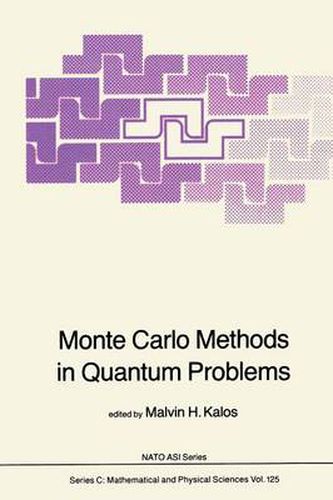
Monte Carlo methods have been a tool of theoretical and computational scientists for many years. In particular, the invention and percolation of the algorithm of Metropolis, Rosenbluth, Rosenbluth, Teller, and Teller sparked a rapid growth of applications to classical statistical mechanics. Although proposals for treatment of quantum systems had been made even earlier, only a few serious calculations had heen carried out. Ruch calculations are generally more consuming of computer resources than for classical systems and no universal algorithm had–or indeed has yet– emerged. However, with advances in techniques and in sheer computing power, Monte Carlo methods have been used with considerable success in treating quantum fluids and crystals, simple models of nuclear matter, and few-body nuclei. Research at several institutions suggest that they may offer a new approach to quantum chemistry, one that is independent of basis ann yet capable of chemical accuracy. That. Monte Carlo methods can attain the very great precision needed is itself a remarkable achievement. More recently, new interest in such methods has arisen in two new a~as. Particle theorists, in particular K. Wilson, have drawn attention to the rich analogy between quantum field theoty and statistical mechanics and to the merits of Monte Carlo calculations for lattice gauge theories. This has become a rapidly growing sub-field. A related development is associated with lattice problems in quantum physics, particularly with models of solid state systems. The~ is much ferment in the calculation of various one-dimensional problems such as the'Hubbard model.
$9.00 standard shipping within Australia
FREE standard shipping within Australia for orders over $100.00
Express & International shipping calculated at checkout
Stock availability can be subject to change without notice. We recommend calling the shop or contacting our online team to check availability of low stock items. Please see our Shopping Online page for more details.
This title is printed to order. This book may have been self-published. If so, we cannot guarantee the quality of the content. In the main most books will have gone through the editing process however some may not. We therefore suggest that you be aware of this before ordering this book. If in doubt check either the author or publisher’s details as we are unable to accept any returns unless they are faulty. Please contact us if you have any questions.
Monte Carlo methods have been a tool of theoretical and computational scientists for many years. In particular, the invention and percolation of the algorithm of Metropolis, Rosenbluth, Rosenbluth, Teller, and Teller sparked a rapid growth of applications to classical statistical mechanics. Although proposals for treatment of quantum systems had been made even earlier, only a few serious calculations had heen carried out. Ruch calculations are generally more consuming of computer resources than for classical systems and no universal algorithm had–or indeed has yet– emerged. However, with advances in techniques and in sheer computing power, Monte Carlo methods have been used with considerable success in treating quantum fluids and crystals, simple models of nuclear matter, and few-body nuclei. Research at several institutions suggest that they may offer a new approach to quantum chemistry, one that is independent of basis ann yet capable of chemical accuracy. That. Monte Carlo methods can attain the very great precision needed is itself a remarkable achievement. More recently, new interest in such methods has arisen in two new a~as. Particle theorists, in particular K. Wilson, have drawn attention to the rich analogy between quantum field theoty and statistical mechanics and to the merits of Monte Carlo calculations for lattice gauge theories. This has become a rapidly growing sub-field. A related development is associated with lattice problems in quantum physics, particularly with models of solid state systems. The~ is much ferment in the calculation of various one-dimensional problems such as the'Hubbard model.
Search our extensive online catalogue.
