Readings Newsletter
Become a Readings Member to make your shopping experience even easier.
Sign in or sign up for free!
You’re not far away from qualifying for FREE standard shipping within Australia
You’ve qualified for FREE standard shipping within Australia
The cart is loading…


This title is printed to order. This book may have been self-published. If so, we cannot guarantee the quality of the content. In the main most books will have gone through the editing process however some may not. We therefore suggest that you be aware of this before ordering this book. If in doubt check either the author or publisher’s details as we are unable to accept any returns unless they are faulty. Please contact us if you have any questions.
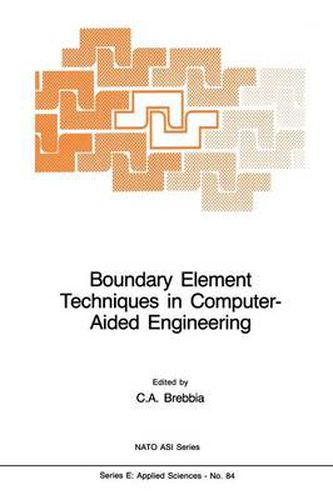
This book constitutes the edited proceedings of the Advanced Studies Institute on Boundary Element Techniques in Computer Aided Engineering held at The Institute of Computational Mechanics, Ashurst Lodge, Southampton, England, from September 19 to 30, 1984. The Institute was held under the auspices of the newly launched Double Jump Programme which aims to bring together academics and industrial scientists. Consequently the programme was more industr ially based than other NATO ASI meetings, achieving an excellent combination of theoretical and practical aspects of the newly developed Boundary Element Method. In recent years engineers have become increasingly interested in the application of boundary element techniques for'the solution of continuum mechanics problems. The importance of boundary elements is that it combines the advantages of boundary integral equations (i.e. reduction of dimensionality of the problems, possibility of modelling domains extending to infinity, numerical accura'cy) with the versatility of finite elements (i.e. modelling of arbitrary curved surfaces). Because of this the technique has been well received by the engineering and scientific communities. Another important advantage of boundary elements stems from its reduction of dimensionality, that is that the technique requires much less data input than classical finite elements. This makes the method very well suited for Computer Aided Design and in great part explains the interest of the engineering profession in the new technique.
$9.00 standard shipping within Australia
FREE standard shipping within Australia for orders over $100.00
Express & International shipping calculated at checkout
Stock availability can be subject to change without notice. We recommend calling the shop or contacting our online team to check availability of low stock items. Please see our Shopping Online page for more details.
This title is printed to order. This book may have been self-published. If so, we cannot guarantee the quality of the content. In the main most books will have gone through the editing process however some may not. We therefore suggest that you be aware of this before ordering this book. If in doubt check either the author or publisher’s details as we are unable to accept any returns unless they are faulty. Please contact us if you have any questions.
This book constitutes the edited proceedings of the Advanced Studies Institute on Boundary Element Techniques in Computer Aided Engineering held at The Institute of Computational Mechanics, Ashurst Lodge, Southampton, England, from September 19 to 30, 1984. The Institute was held under the auspices of the newly launched Double Jump Programme which aims to bring together academics and industrial scientists. Consequently the programme was more industr ially based than other NATO ASI meetings, achieving an excellent combination of theoretical and practical aspects of the newly developed Boundary Element Method. In recent years engineers have become increasingly interested in the application of boundary element techniques for'the solution of continuum mechanics problems. The importance of boundary elements is that it combines the advantages of boundary integral equations (i.e. reduction of dimensionality of the problems, possibility of modelling domains extending to infinity, numerical accura'cy) with the versatility of finite elements (i.e. modelling of arbitrary curved surfaces). Because of this the technique has been well received by the engineering and scientific communities. Another important advantage of boundary elements stems from its reduction of dimensionality, that is that the technique requires much less data input than classical finite elements. This makes the method very well suited for Computer Aided Design and in great part explains the interest of the engineering profession in the new technique.
Search our extensive online catalogue.
