Readings Newsletter
Become a Readings Member to make your shopping experience even easier.
Sign in or sign up for free!
You’re not far away from qualifying for FREE standard shipping within Australia
You’ve qualified for FREE standard shipping within Australia
The cart is loading…


This title is printed to order. This book may have been self-published. If so, we cannot guarantee the quality of the content. In the main most books will have gone through the editing process however some may not. We therefore suggest that you be aware of this before ordering this book. If in doubt check either the author or publisher’s details as we are unable to accept any returns unless they are faulty. Please contact us if you have any questions.
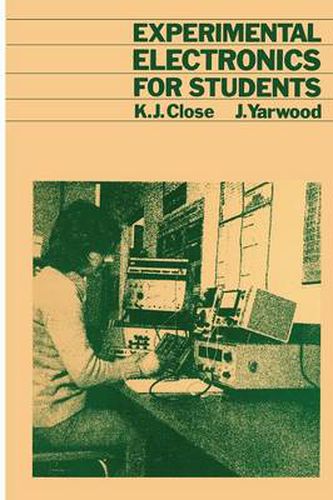
Electronics is essentially an experimental subject and enables a wealth of experimental work to be undertaken at relatively low cost. In any modestly equipped electrical engineering or physics laboratory. it is possible to plan interesting experiments to study active and passive com ponents, basic circuit functions, modular encapsulations and monolithic integrated circuits. The work may range from the formal investigation of a device new to the student to the design and construction of quite advanced, modern measurement and control systems. There are few books which guide experimental work in electronics. This text aims to rectify this by giving detailed descriptions of a series of experiments all of which have been thoroughly tested by students in physics, electronics, electrical engineering and instrumentation at The Polytechnic of Central London. Moreover, several of these experiments would seem to be appropriate for the current development of interest in courses in electronics in schools because several of them have been undertaken with considerable success by first-year sixth-form students who have come to Central London for special courses. They would also assist an introductory course in electronics for students from other disciplines and have been tried out in this way at The Polytechnic.
$9.00 standard shipping within Australia
FREE standard shipping within Australia for orders over $100.00
Express & International shipping calculated at checkout
Stock availability can be subject to change without notice. We recommend calling the shop or contacting our online team to check availability of low stock items. Please see our Shopping Online page for more details.
This title is printed to order. This book may have been self-published. If so, we cannot guarantee the quality of the content. In the main most books will have gone through the editing process however some may not. We therefore suggest that you be aware of this before ordering this book. If in doubt check either the author or publisher’s details as we are unable to accept any returns unless they are faulty. Please contact us if you have any questions.
Electronics is essentially an experimental subject and enables a wealth of experimental work to be undertaken at relatively low cost. In any modestly equipped electrical engineering or physics laboratory. it is possible to plan interesting experiments to study active and passive com ponents, basic circuit functions, modular encapsulations and monolithic integrated circuits. The work may range from the formal investigation of a device new to the student to the design and construction of quite advanced, modern measurement and control systems. There are few books which guide experimental work in electronics. This text aims to rectify this by giving detailed descriptions of a series of experiments all of which have been thoroughly tested by students in physics, electronics, electrical engineering and instrumentation at The Polytechnic of Central London. Moreover, several of these experiments would seem to be appropriate for the current development of interest in courses in electronics in schools because several of them have been undertaken with considerable success by first-year sixth-form students who have come to Central London for special courses. They would also assist an introductory course in electronics for students from other disciplines and have been tried out in this way at The Polytechnic.
Search our extensive online catalogue.
