Readings Newsletter
Become a Readings Member to make your shopping experience even easier.
Sign in or sign up for free!
You’re not far away from qualifying for FREE standard shipping within Australia
You’ve qualified for FREE standard shipping within Australia
The cart is loading…


This title is printed to order. This book may have been self-published. If so, we cannot guarantee the quality of the content. In the main most books will have gone through the editing process however some may not. We therefore suggest that you be aware of this before ordering this book. If in doubt check either the author or publisher’s details as we are unable to accept any returns unless they are faulty. Please contact us if you have any questions.
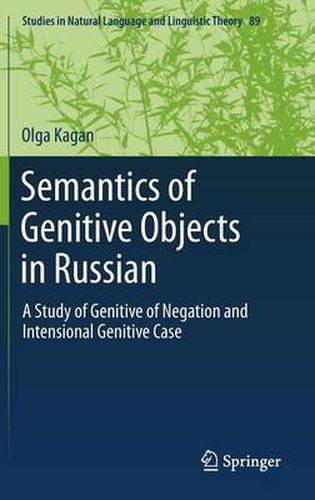
The genitive/accusative opposition in Slavic languages is a decades-old linguistic conundrum. Shedding new light on this perplexing object-case alternation in Russian, this volume analyzes two variants of genitive objects that alternate with accusative complements-the genitive of negation and the intensional genitive. The author contends that these variants are manifestations of the same phenomenon, and thus require an integrated analysis. Further, that the choice of case is sensitive to factors that fuse semantics and pragmatics, and that the genitive case is assigned to objects denoting properties at the same time as they lack commitment to existence.
Kagan’s subtle analysis accounts for the complex relations between case-marking and other properties, such as definiteness, specificity, number and aspect. It also reveals a correlation between the genitive case and the subjunctive mood, and relates her overarching subject matter to other instances of differential object-marking.
$9.00 standard shipping within Australia
FREE standard shipping within Australia for orders over $100.00
Express & International shipping calculated at checkout
Stock availability can be subject to change without notice. We recommend calling the shop or contacting our online team to check availability of low stock items. Please see our Shopping Online page for more details.
This title is printed to order. This book may have been self-published. If so, we cannot guarantee the quality of the content. In the main most books will have gone through the editing process however some may not. We therefore suggest that you be aware of this before ordering this book. If in doubt check either the author or publisher’s details as we are unable to accept any returns unless they are faulty. Please contact us if you have any questions.
The genitive/accusative opposition in Slavic languages is a decades-old linguistic conundrum. Shedding new light on this perplexing object-case alternation in Russian, this volume analyzes two variants of genitive objects that alternate with accusative complements-the genitive of negation and the intensional genitive. The author contends that these variants are manifestations of the same phenomenon, and thus require an integrated analysis. Further, that the choice of case is sensitive to factors that fuse semantics and pragmatics, and that the genitive case is assigned to objects denoting properties at the same time as they lack commitment to existence.
Kagan’s subtle analysis accounts for the complex relations between case-marking and other properties, such as definiteness, specificity, number and aspect. It also reveals a correlation between the genitive case and the subjunctive mood, and relates her overarching subject matter to other instances of differential object-marking.
Search our extensive online catalogue.
