Readings Newsletter
Become a Readings Member to make your shopping experience even easier.
Sign in or sign up for free!
You’re not far away from qualifying for FREE standard shipping within Australia
You’ve qualified for FREE standard shipping within Australia
The cart is loading…


This title is printed to order. This book may have been self-published. If so, we cannot guarantee the quality of the content. In the main most books will have gone through the editing process however some may not. We therefore suggest that you be aware of this before ordering this book. If in doubt check either the author or publisher’s details as we are unable to accept any returns unless they are faulty. Please contact us if you have any questions.
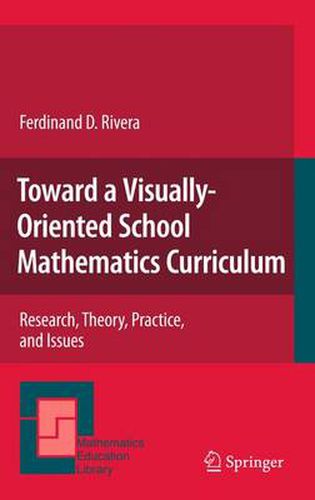
What does it mean to have a visual representation of a mathematical object, concept, or process? What visualization strategies support growth in mathematical thinking, reasoning, generalization, and knowledge? Is mathematical seeing culture-free? How can information drawn from studies in blind subjects help us understand the significance of a multimodal approach to learning mathematics? Toward a Visually-Oriented School Mathematics Curriculum explores a unified theory of visualization in school mathematical learning via the notion of progressive modeling. Based on the author’s longitudinal research investigations in elementary and middle school classrooms, the book provides a compelling empirical account of ways in which instruction can effectively orchestrate the transition from personally-constructed visuals, both externally-drawn and internally-derived, into more structured visual representations within the context of a socioculturally grounded mathematical activity. Both for teachers and researchers, a discussion of this topic is relevant in the history of the present. The ubiquity of technological tools and virtual spaces for learning and doing mathematics has aroused interest among concerned stakeholders about the role of mathematics in these contexts. The book begins with a prolegomenon on the author’s reflections on past and present visual studies in mathematics education. In the remaining seven chapters, visualization is pursued in terms of its role in bringing about progressions in mathematical symbolization, abduction, pattern generalization, and diagrammatization. Toward a Visually-Oriented School Mathematics Curriculum views issues surrounding visualization through the eyes of a classroom teacher-researcher; it draws on findings within and outside of mathematics education that help practitioners and scholars gain a better understanding of what it means to pleasurably experience the symmetric visual/symbolic reversal phenomenon - that is, seeing the visual in the symbolic and the symbolic in the visual.
$9.00 standard shipping within Australia
FREE standard shipping within Australia for orders over $100.00
Express & International shipping calculated at checkout
Stock availability can be subject to change without notice. We recommend calling the shop or contacting our online team to check availability of low stock items. Please see our Shopping Online page for more details.
This title is printed to order. This book may have been self-published. If so, we cannot guarantee the quality of the content. In the main most books will have gone through the editing process however some may not. We therefore suggest that you be aware of this before ordering this book. If in doubt check either the author or publisher’s details as we are unable to accept any returns unless they are faulty. Please contact us if you have any questions.
What does it mean to have a visual representation of a mathematical object, concept, or process? What visualization strategies support growth in mathematical thinking, reasoning, generalization, and knowledge? Is mathematical seeing culture-free? How can information drawn from studies in blind subjects help us understand the significance of a multimodal approach to learning mathematics? Toward a Visually-Oriented School Mathematics Curriculum explores a unified theory of visualization in school mathematical learning via the notion of progressive modeling. Based on the author’s longitudinal research investigations in elementary and middle school classrooms, the book provides a compelling empirical account of ways in which instruction can effectively orchestrate the transition from personally-constructed visuals, both externally-drawn and internally-derived, into more structured visual representations within the context of a socioculturally grounded mathematical activity. Both for teachers and researchers, a discussion of this topic is relevant in the history of the present. The ubiquity of technological tools and virtual spaces for learning and doing mathematics has aroused interest among concerned stakeholders about the role of mathematics in these contexts. The book begins with a prolegomenon on the author’s reflections on past and present visual studies in mathematics education. In the remaining seven chapters, visualization is pursued in terms of its role in bringing about progressions in mathematical symbolization, abduction, pattern generalization, and diagrammatization. Toward a Visually-Oriented School Mathematics Curriculum views issues surrounding visualization through the eyes of a classroom teacher-researcher; it draws on findings within and outside of mathematics education that help practitioners and scholars gain a better understanding of what it means to pleasurably experience the symmetric visual/symbolic reversal phenomenon - that is, seeing the visual in the symbolic and the symbolic in the visual.
Search our extensive online catalogue.
