Readings Newsletter
Become a Readings Member to make your shopping experience even easier.
Sign in or sign up for free!
You’re not far away from qualifying for FREE standard shipping within Australia
You’ve qualified for FREE standard shipping within Australia
The cart is loading…


This title is printed to order. This book may have been self-published. If so, we cannot guarantee the quality of the content. In the main most books will have gone through the editing process however some may not. We therefore suggest that you be aware of this before ordering this book. If in doubt check either the author or publisher’s details as we are unable to accept any returns unless they are faulty. Please contact us if you have any questions.
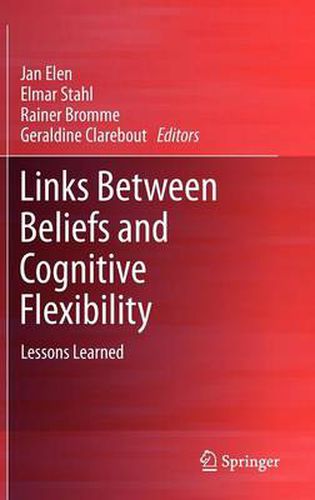
With the world and its structures becoming ever more complex, and the nature of future employment becoming ever more unpredictable, the notion of ‘cognitive flexibility’ has a high profile in educational and psychological debate. The contributions in this volume analyze the nature of cognitive flexibility, as well as the impact of different types of beliefs on cognitive flexibility.
Making adequate decisions requires considering input from a variety of continuously evolving sources rather than adhering to predetermined procedures. Adopting a position in a debate necessitates the critical evaluation of different alternatives, while solving a problem entails selecting appropriate problem-solving strategies. Meanwhile, studying requires students to integrate a range of interventions, and treating a patient involves making a differential diagnosis. The common factor, cognitive flexibility, lies at the core of effective functioning in complex, domain-specific environments.
Cognitive flexibility can be described as the disposition to consider diverse information elements while deciding on how to solve a problem or to execute a learning-related task in a variety of domains. The concept of ‘disposition’ implies that individuals will not always demonstrate cognitive flexibility even if they are in principle able to act in a cognitively flexible way. The notion does not require that alternatives are always deliberately considered, which is why this volume’s tandem discussion of beliefs is key element of the discussion. Beliefs play a central role in cognitive flexibility and relate to what individuals consider to be important, valid and/or true. Of specific interest is the relationship between epistemological beliefs and cognitive flexibility, especially as a particular subset of epistemological beliefs seems to be a prerequisite to a cognitively flexible disposition.
$9.00 standard shipping within Australia
FREE standard shipping within Australia for orders over $100.00
Express & International shipping calculated at checkout
Stock availability can be subject to change without notice. We recommend calling the shop or contacting our online team to check availability of low stock items. Please see our Shopping Online page for more details.
This title is printed to order. This book may have been self-published. If so, we cannot guarantee the quality of the content. In the main most books will have gone through the editing process however some may not. We therefore suggest that you be aware of this before ordering this book. If in doubt check either the author or publisher’s details as we are unable to accept any returns unless they are faulty. Please contact us if you have any questions.
With the world and its structures becoming ever more complex, and the nature of future employment becoming ever more unpredictable, the notion of ‘cognitive flexibility’ has a high profile in educational and psychological debate. The contributions in this volume analyze the nature of cognitive flexibility, as well as the impact of different types of beliefs on cognitive flexibility.
Making adequate decisions requires considering input from a variety of continuously evolving sources rather than adhering to predetermined procedures. Adopting a position in a debate necessitates the critical evaluation of different alternatives, while solving a problem entails selecting appropriate problem-solving strategies. Meanwhile, studying requires students to integrate a range of interventions, and treating a patient involves making a differential diagnosis. The common factor, cognitive flexibility, lies at the core of effective functioning in complex, domain-specific environments.
Cognitive flexibility can be described as the disposition to consider diverse information elements while deciding on how to solve a problem or to execute a learning-related task in a variety of domains. The concept of ‘disposition’ implies that individuals will not always demonstrate cognitive flexibility even if they are in principle able to act in a cognitively flexible way. The notion does not require that alternatives are always deliberately considered, which is why this volume’s tandem discussion of beliefs is key element of the discussion. Beliefs play a central role in cognitive flexibility and relate to what individuals consider to be important, valid and/or true. Of specific interest is the relationship between epistemological beliefs and cognitive flexibility, especially as a particular subset of epistemological beliefs seems to be a prerequisite to a cognitively flexible disposition.
Search our extensive online catalogue.
