Readings Newsletter
Become a Readings Member to make your shopping experience even easier.
Sign in or sign up for free!
You’re not far away from qualifying for FREE standard shipping within Australia
You’ve qualified for FREE standard shipping within Australia
The cart is loading…


This title is printed to order. This book may have been self-published. If so, we cannot guarantee the quality of the content. In the main most books will have gone through the editing process however some may not. We therefore suggest that you be aware of this before ordering this book. If in doubt check either the author or publisher’s details as we are unable to accept any returns unless they are faulty. Please contact us if you have any questions.
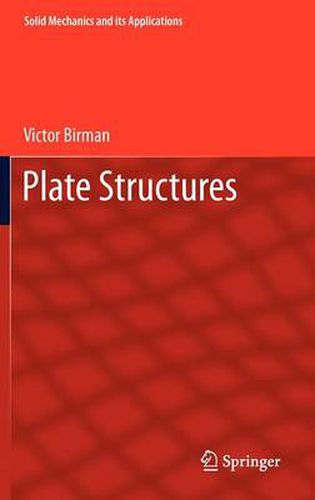
Plate structures are used in almost every area of engineering, including aerospace and naval architecture, civil engineering, and electronics. These structures have diverse geometries and have to withstand a wide range of loading conditions. This book provides the theoretical foundations of the theories of plates manufactured from various materials, outlines and illustrates the methods used for the analysis of these structures, and emphasizes designs and solution techniques available to an engineer. The book is written for engineers working in industry, graduate students at aerospace, mechanical, civil engineering and naval architecture departments, and investigators interested in the development of the theory of plates and related subjects. While the mathematical modeling employed in the book is understandable to both engineers and graduate students, the book also provides insight into relevant phenomena and theories underlying plate structures. Thus, the reader is equipped with a thorough understanding of the problems and appropriate assumptions, even if the analysis is conducted using commercially available software codes. In addition, the book includes numerous analytical solutions that can confidently be used in the design of plate structures. The combination of theoretical insight and references to practical problems makes the book equally attractive to academia and industry.
$9.00 standard shipping within Australia
FREE standard shipping within Australia for orders over $100.00
Express & International shipping calculated at checkout
Stock availability can be subject to change without notice. We recommend calling the shop or contacting our online team to check availability of low stock items. Please see our Shopping Online page for more details.
This title is printed to order. This book may have been self-published. If so, we cannot guarantee the quality of the content. In the main most books will have gone through the editing process however some may not. We therefore suggest that you be aware of this before ordering this book. If in doubt check either the author or publisher’s details as we are unable to accept any returns unless they are faulty. Please contact us if you have any questions.
Plate structures are used in almost every area of engineering, including aerospace and naval architecture, civil engineering, and electronics. These structures have diverse geometries and have to withstand a wide range of loading conditions. This book provides the theoretical foundations of the theories of plates manufactured from various materials, outlines and illustrates the methods used for the analysis of these structures, and emphasizes designs and solution techniques available to an engineer. The book is written for engineers working in industry, graduate students at aerospace, mechanical, civil engineering and naval architecture departments, and investigators interested in the development of the theory of plates and related subjects. While the mathematical modeling employed in the book is understandable to both engineers and graduate students, the book also provides insight into relevant phenomena and theories underlying plate structures. Thus, the reader is equipped with a thorough understanding of the problems and appropriate assumptions, even if the analysis is conducted using commercially available software codes. In addition, the book includes numerous analytical solutions that can confidently be used in the design of plate structures. The combination of theoretical insight and references to practical problems makes the book equally attractive to academia and industry.
Search our extensive online catalogue.
