Readings Newsletter
Become a Readings Member to make your shopping experience even easier.
Sign in or sign up for free!
You’re not far away from qualifying for FREE standard shipping within Australia
You’ve qualified for FREE standard shipping within Australia
The cart is loading…


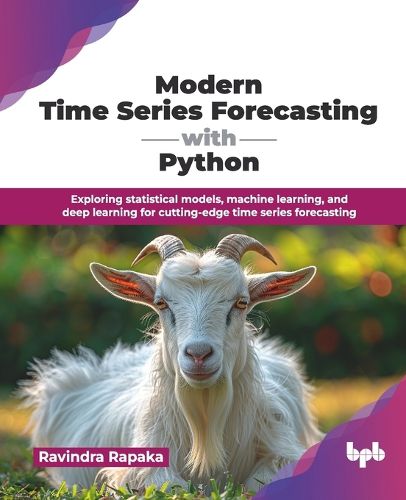
Time series forecasting is driving decision-making in everything from financial markets to supply chain logistics. This book provides a hands-on roadmap to mastering this technology, bridging the gap between classical statistical rigor and cutting-edge artificial intelligence.
Understand time series fundamentals by exploring decomposition, stationarity, and ACF/PACF analysis before mastering preprocessing and feature engineering. You will build foundational ARIMA, SARIMA, and Holt-Winters' models before pivoting to machine learning with XGBoost and Scikit-learn. The journey accelerates into deep learning, designing RNNs, LSTMs, and hybrid CNN-LSTM architectures for univariate and multivariate forecasting. After exploring advanced VAR and VECM models, you will implement walk-forward validation and professional error metrics. The final sections cover scalability and MLOps, teaching you to handle big data with Dask and deploy production-ready models via FastAPI and Apache Kafka.
By the end of this book, you will be a competent practitioner capable of building high-performance forecasting pipelines for stock prices, demand, and sensor data. You will possess the technical expertise to deploy scalable, ethical, and accurate models in real-world cloud environments with confidence.
What you will learn
? Diagnose trend and seasonality using Statsmodels stationarity.
? Build ARIMA/SARIMA and smoothing models using Statsmodels.
? Engineer lag, rolling, and calendar-based forecasting features.
? Deploy FastAPI pipelines and monitor Kafka drift.
? Build LSTM and GRU architectures with TensorFlow.
? Backtest, compare, and ensemble models with confidence.
? Deploy, monitor, and retrain forecasting pipelines at scale.
Who this book is for
This book is designed for data scientists, machine learning engineers, and analysts mastering temporal data. Proficiency in Python and basic statistics is required, while experience with cloud deployment or deep learning helps professional engineers scale models using the featured technical frameworks.
Table of Contents
Introduction to Time Series Data and Analysis
Data Pre-processing and Feature Engineering
Exploratory and Statistical Analysis of Time Series
Autoregressive Models
Moving Average and ARMA Models
ARIMA and SARIMA Models
Exponential Smoothing Methods
Feature-based Machine Learning for Time Series Forecasting
Introduction to Deep Learning for Time Series
Building and Training LSTM Models for Time Series
Advanced Deep Learning Architectures and Multivariate Forecasting
Multivariate Time Series Forecasting
Model Evaluation, Selection, and Ensembling
Forecasting at Scale and Model Deployment
Time Series Forecasting in Practice
$9.00 standard shipping within Australia
FREE standard shipping within Australia for orders over $100.00
Express & International shipping calculated at checkout
Stock availability can be subject to change without notice. We recommend calling the shop or contacting our online team to check availability of low stock items. Please see our Shopping Online page for more details.
Time series forecasting is driving decision-making in everything from financial markets to supply chain logistics. This book provides a hands-on roadmap to mastering this technology, bridging the gap between classical statistical rigor and cutting-edge artificial intelligence.
Understand time series fundamentals by exploring decomposition, stationarity, and ACF/PACF analysis before mastering preprocessing and feature engineering. You will build foundational ARIMA, SARIMA, and Holt-Winters' models before pivoting to machine learning with XGBoost and Scikit-learn. The journey accelerates into deep learning, designing RNNs, LSTMs, and hybrid CNN-LSTM architectures for univariate and multivariate forecasting. After exploring advanced VAR and VECM models, you will implement walk-forward validation and professional error metrics. The final sections cover scalability and MLOps, teaching you to handle big data with Dask and deploy production-ready models via FastAPI and Apache Kafka.
By the end of this book, you will be a competent practitioner capable of building high-performance forecasting pipelines for stock prices, demand, and sensor data. You will possess the technical expertise to deploy scalable, ethical, and accurate models in real-world cloud environments with confidence.
What you will learn
? Diagnose trend and seasonality using Statsmodels stationarity.
? Build ARIMA/SARIMA and smoothing models using Statsmodels.
? Engineer lag, rolling, and calendar-based forecasting features.
? Deploy FastAPI pipelines and monitor Kafka drift.
? Build LSTM and GRU architectures with TensorFlow.
? Backtest, compare, and ensemble models with confidence.
? Deploy, monitor, and retrain forecasting pipelines at scale.
Who this book is for
This book is designed for data scientists, machine learning engineers, and analysts mastering temporal data. Proficiency in Python and basic statistics is required, while experience with cloud deployment or deep learning helps professional engineers scale models using the featured technical frameworks.
Table of Contents
Introduction to Time Series Data and Analysis
Data Pre-processing and Feature Engineering
Exploratory and Statistical Analysis of Time Series
Autoregressive Models
Moving Average and ARMA Models
ARIMA and SARIMA Models
Exponential Smoothing Methods
Feature-based Machine Learning for Time Series Forecasting
Introduction to Deep Learning for Time Series
Building and Training LSTM Models for Time Series
Advanced Deep Learning Architectures and Multivariate Forecasting
Multivariate Time Series Forecasting
Model Evaluation, Selection, and Ensembling
Forecasting at Scale and Model Deployment
Time Series Forecasting in Practice
Search our extensive online catalogue.
