Readings Newsletter
Become a Readings Member to make your shopping experience even easier.
Sign in or sign up for free!
You’re not far away from qualifying for FREE standard shipping within Australia
You’ve qualified for FREE standard shipping within Australia
The cart is loading…


This title is printed to order. This book may have been self-published. If so, we cannot guarantee the quality of the content. In the main most books will have gone through the editing process however some may not. We therefore suggest that you be aware of this before ordering this book. If in doubt check either the author or publisher’s details as we are unable to accept any returns unless they are faulty. Please contact us if you have any questions.
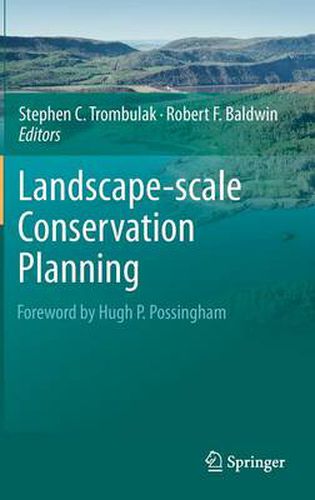
Hugh P. Possingham Landscape-scale conservation planning is coming of age. In the last couple of decades, conservation practitioners, working at all levels of governance and all spatial scales, have embraced the CARE principles of conservation planning - Comprehensiveness, Adequacy, Representativeness, and Efficiency. Hundreds of papers have been written on this theme, and several different kinds of software program have been developed and used around the world, making conservation planning based on these principles global in its reach and influence. Does this mean that all the science of conservation planning is over - that the discovery phase has been replaced by an engineering phase as we move from defining the rules to implementing them in the landscape? This book and the continuing growth in the literature suggest that the answer to this question is most definitely ‘no. ’ All of applied conservation can be wrapped up into a single sentence: what should be done (the action), in what place, at what time, using what mechanism, and for what outcome (the objective). It all seems pretty simple - what, where, when, how and why. However stating a problem does not mean it is easy to solve.
$9.00 standard shipping within Australia
FREE standard shipping within Australia for orders over $100.00
Express & International shipping calculated at checkout
Stock availability can be subject to change without notice. We recommend calling the shop or contacting our online team to check availability of low stock items. Please see our Shopping Online page for more details.
This title is printed to order. This book may have been self-published. If so, we cannot guarantee the quality of the content. In the main most books will have gone through the editing process however some may not. We therefore suggest that you be aware of this before ordering this book. If in doubt check either the author or publisher’s details as we are unable to accept any returns unless they are faulty. Please contact us if you have any questions.
Hugh P. Possingham Landscape-scale conservation planning is coming of age. In the last couple of decades, conservation practitioners, working at all levels of governance and all spatial scales, have embraced the CARE principles of conservation planning - Comprehensiveness, Adequacy, Representativeness, and Efficiency. Hundreds of papers have been written on this theme, and several different kinds of software program have been developed and used around the world, making conservation planning based on these principles global in its reach and influence. Does this mean that all the science of conservation planning is over - that the discovery phase has been replaced by an engineering phase as we move from defining the rules to implementing them in the landscape? This book and the continuing growth in the literature suggest that the answer to this question is most definitely ‘no. ’ All of applied conservation can be wrapped up into a single sentence: what should be done (the action), in what place, at what time, using what mechanism, and for what outcome (the objective). It all seems pretty simple - what, where, when, how and why. However stating a problem does not mean it is easy to solve.
Search our extensive online catalogue.
